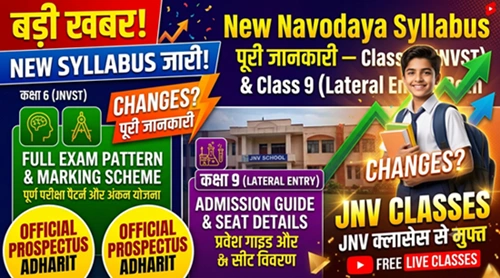
Navodaya Syllabus 2027 —
Class 6 (JNVST) और Class 9 (Lateral Entry) दोनों
यहाँ पूरा Navodaya Syllabus Subject-wise और Topic-wise दिया गया है — Class VI JNVST Selection Test और Class IX Lateral Entry Selection Test, दोनों का। यह पूरी जानकारी Navodaya Vidyalaya Samiti (NVS) के Official Syllabus Document से ली गई है, ताकि आपको हर Topic बिल्कुल सही मिले।
JNVST 2027 की तैयारी की पहली सीढ़ी सही Navodaya Syllabus जानना है। बिना Syllabus समझे Practice करना समय की बर्बादी है, इसलिए JNV Classes ने Official Prospectus से लिया गया पूरा Navodaya Syllabus — Class 6 और Class 9, दोनों का — Subject-wise और Topic-wise यहाँ व्यवस्थित किया है। नीचे पहले Class 6 का पूरा Syllabus दिया गया है, उसके बाद Class 9 का — साथ में Practice Sets और Online Course के Links भी हैं।
यह पूरा Navodaya Syllabus पेज Official Syllabus Document से एक-एक शब्द पढ़कर तैयार किया गया है, ताकि Student या Parent को कहीं और भटकना न पड़े और सही Topics पर ही समय लगाया जाए।
📌 ज़रूरी जानकारी: इस पेज पर हर Section में सबसे पहले Official Prospectus का Original अंग्रेज़ी Text — बिल्कुल Word-by-Word, बिना किसी बदलाव के — दिया गया है, और उसके ठीक नीचे उसी Content का Hindi अनुवाद है। इस तरह यह Navodaya Syllabus हर Student के लिए — चाहे वह Hindi Medium का हो या English Medium का — समझने में बिल्कुल आसान बन जाता है। नीचे Class 6 और Class 9, दोनों का पूरा Navodaya Syllabus दोनों भाषाओं में उपलब्ध है।
Navodaya Syllabus — Class 6 (JNVST 2027)
यह JNV Class 6 Syllabus 2027 Official NVS Prospectus से Word-by-Word लिया गया है। हर Section पहले Official English Text में (जैसा Prospectus में है) और फिर आसानी से समझने के लिए Hindi अनुवाद में दिया गया है। यही Class 6 वाला Navodaya Syllabus है, जिसे बिना किसी बदलाव के यहाँ रखा गया है।
🧩 Section 1 — Mental Ability Test (MAT) and Environmental Studies (EVS)
“This is a non-verbal test. Questions are based on figures and diagrams only. Questions are meant to assess general mental ability/functioning of the candidates. The section is divided into five parts having 4 questions each from mental ability and remaining 20 questions are from Environmental Studies.”
- Part-I (Pattern Completion) — Including Alphabetical and number patterns
- Part-II (Figure Series Completion)
- Part-III (Geometrical Figure Completion — Triangle, Square, Circle)
- Part-IV (Mirror and Water Imaging)
- Part-V (Embedded Figure)
“यह एक Non-Verbal Test है। प्रश्न केवल Figures और Diagrams पर आधारित होते हैं। प्रश्नों का उद्देश्य उम्मीदवारों की सामान्य मानसिक क्षमता/कार्यप्रणाली का आकलन करना है। यह Section पाँच भागों में बंटा है, जिनमें से हर भाग में Mental Ability के 4 प्रश्न होते हैं और शेष 20 प्रश्न Environmental Studies से होते हैं।”
- भाग-I (पैटर्न पूर्ण करना) — वर्णमाला व संख्या पैटर्न सहित
- भाग-II (आकृति श्रृंखला पूर्ण करना)
- भाग-III (ज्यामितीय आकृति पूर्ण करना — त्रिभुज, वर्ग, वृत्त)
- भाग-IV (दर्पण व जल प्रतिबिंब)
- भाग-V (छिपी हुई आकृति)
🔎 यह Section भी Class 6 वाले Navodaya Syllabus का Official Word-by-Word अंश है।
🌍 Environmental Studies (EVS) — Questions 21-40
“QUESTION NO. 21-40 will be given from Environmental Studies (EVS). The test consists of 20 questions containing 15 MCQs and one passage followed by 05 questions. EVS takes an interdisciplinary approach, integrating basic concepts from Science, Social Science and Environmental Education. The main purpose of this test is to assess basic awareness of the candidates about their surroundings.”
- The Natural world (Transportation, Rivers, Mountains, Plants and animals on land and water, natural disasters, types of houses/shelters, water cycle etc.)
- The Human body (Food and nutrients, hygiene and cleanliness, super senses, basic knowledge of internal systems – digestive, circulatory, respiratory etc.)
- Science in daily life (Food preservation, Water and air pollution, Conservation of water and soil etc.)
- Social Surroundings (Superlatives of India, States/Capitals, national symbols, different landscapes, Festivals, seasons, Forests, crops, clothes and fibres etc.)
“प्रश्न संख्या 21-40 Environmental Studies (EVS) से होंगे। इस Test में 20 प्रश्न होते हैं, जिनमें 15 MCQs और एक Passage होता है जिसके बाद 05 प्रश्न आते हैं। EVS एक Interdisciplinary Approach अपनाता है, जिसमें Science, Social Science और Environmental Education की बुनियादी अवधारणाएँ शामिल होती हैं। इस Test का मुख्य उद्देश्य उम्मीदवारों की अपने आस-पास के परिवेश के बारे में बुनियादी जागरूकता का आकलन करना है।”
- प्राकृतिक जगत (परिवहन, नदियाँ, पहाड़, जल व थल के पेड़-पौधे और जानवर, प्राकृतिक आपदाएँ, घरों/आश्रयों के प्रकार, जल चक्र आदि)
- मानव शरीर (भोजन व पोषक तत्व, स्वच्छता, विशेष इंद्रियाँ, आंतरिक तंत्रों — पाचन, परिसंचरण, श्वसन — की बुनियादी जानकारी)
- दैनिक जीवन में विज्ञान (खाद्य परिरक्षण, जल व वायु प्रदूषण, जल व मृदा संरक्षण आदि)
- सामाजिक परिवेश (भारत की विशेषताएँ, राज्य/राजधानियाँ, राष्ट्रीय प्रतीक, विभिन्न भू-दृश्य, त्योहार, ऋतुएँ, वन, फसलें, वस्त्र व रेशे आदि)
🔎 Arithmetic का यह Content भी Official Navodaya Syllabus Document से जस का तस लिया गया है।
➗ Section 2 — Arithmetic Test
“The main purpose of this test is to measure candidate’s basic competencies in Arithmetic. All the Twenty questions of this test will be based on the following topics:”
- Number and numeric system including ascending, descending, nearest, 10/100/1000 number names and value
- Four fundamental operations on whole number
- Factors and multiples including their properties
- Fractions and fundamental operations — addition and subtraction of like fraction and multiplication (unlike fraction and division of fractional numbers not included)
- Measurement of length, mass, capacity, time, money and unit conversion etc.
- Simplification of Numerical Expressions
- Perimeter and area – perimeter of polygon, area of square rectangle and triangle (as a part of rectangle)
- Types of angles and its simple applications (including directions and mapping)
- Data analysis using bar diagram, table and pictograph
“इस Test का मुख्य उद्देश्य उम्मीदवार की Arithmetic में बुनियादी योग्यता को मापना है। इस Test के सभी बीस प्रश्न निम्नलिखित विषयों पर आधारित होंगे:”
- संख्या और संख्या पद्धति — आरोही, अवरोही, निकटतम 10/100/1000, संख्या नाम व मान सहित
- पूर्ण संख्याओं पर चार मूल संक्रियाएँ
- गुणनखंड व गुणज तथा उनके गुण
- भिन्न और मूल संक्रियाएँ — समान भिन्नों का जोड़-घटाव और गुणा (असमान भिन्न व भिन्नों का भाग शामिल नहीं)
- लंबाई, भार, धारिता, समय, धन का मापन व Unit Conversion आदि
- संख्यात्मक व्यंजकों का सरलीकरण
- परिमाप व क्षेत्रफल — बहुभुज का परिमाप, वर्ग-आयत-त्रिभुज (आयत के भाग रूप में) का क्षेत्रफल
- कोणों के प्रकार व उनके सरल अनुप्रयोग (दिशाएँ व मानचित्रण सहित)
- दंड आरेख, तालिका व चित्रालेख का उपयोग करते हुए Data Analysis
🔎 Language Test का Content भी Class 6 वाले Navodaya Syllabus का Official हिस्सा है।
📖 Section 3 — Language Test
“The main purpose of this test is to assess reading comprehension of the candidates. The test consists of four passages. Each passage is followed by 5 questions.”
“इस Test का मुख्य उद्देश्य उम्मीदवारों की Reading Comprehension क्षमता का आकलन करना है। इस Test में चार Passages होते हैं। हर Passage के बाद 5 प्रश्न आते हैं।”
Class 6 Exam Pattern & Marking — Navodaya Syllabus Exam Pattern
| Section | प्रश्न | अंक | समय |
|---|---|---|---|
| Mental Ability Test + EVS | 20 + 20 | 25 + 25 | 60 मिनट |
| Arithmetic Test | 20 | 25 | 30 मिनट |
| Language Test | 20 | 25 | 30 मिनट |
| Total | 80 | 100 | 2 घंटे |
हर सही उत्तर पर 1.25 अंक मिलते हैं, कोई Negative Marking नहीं। OMR Sheet पर केवल Blue/Black Ball Point Pen से जवाब भरने होते हैं — Pencil सख्त वर्जित है। Section-wise Minimum Qualifying Marks: MAT+EVS में 14, Arithmetic में 07, Language में 07 अंक लाना अनिवार्य है। पूरा Exam Pattern और Admission Process यहाँ देखें।
Class 6 Model Papers (10/25/50/100) + Course
पूरा Navodaya Syllabus पढ़ने के बाद, Practice के लिए JNV Classes के पास Class 6 के लिए 10, 25, 50 और 100 Model Papers तक के Package उपलब्ध हैं, साथ ही Hindi और English Medium दोनों में पूरा Online Course भी।
Navodaya Syllabus — Class 9 (Lateral Entry 2027-28)
Navodaya Class 9 Syllabus 2027 यहाँ Official Syllabus Document से Word-by-Word लिया गया है — हर Subject पहले Official Text में और फिर Hindi अनुवाद में, ताकि समझना आसान हो। यह Class 9 का Navodaya Syllabus बिना किसी बदलाव के, ठीक Official Document जैसा ही रखा गया है।
🔎 Class 9 वाले Navodaya Syllabus की शुरुआत English Subject से — पूरा Official Text नीचे दिया गया है।
🔤 Subject: English — Maximum Marks: 15
- Comprehension (Unseen Passage)
- Word and Sentence
- Structure Spelling
- Rearranging jumbled words
- Passivation
- Use of degrees of comparison
- Modal auxiliaries
- Use of prepositions
- Tense forms
- Reported speech
- गद्यांश (अपठित गद्यांश)
- शब्द व वाक्य रचना
- वाक्य संरचना व वर्तनी (Spelling)
- उलझे हुए शब्दों को व्यवस्थित करना
- वाक्य को Passive Voice में बदलना
- तुलना की मात्राओं (Degrees of Comparison) का प्रयोग
- Modal Auxiliaries का प्रयोग
- Prepositions का प्रयोग
- Tense Forms
- Reported Speech (कथित वाणी)
🔎 हिंदी विषय का यह Navodaya Syllabus भी Official Document जैसा ही, बिना बदलाव के रखा गया है।
🅰️ विषय: हिंदी — अंक: 15 (बहुविकल्पीय प्रश्न)
(क) भाषिक अनुप्रयोग और व्याकरणिक कुशलताएँ
- वर्ण विचार / वर्तनी विवेक
- शब्द-भेद (स्रोत/उत्पत्ति)
- पर्याय / विलोम
- शब्द विवेक (शब्द प्रयोग में सूक्ष्म अंतर)
- पद भेद (व्याकरणिक कोटि) की पहचान
- पद परिचय
- अशुद्ध वाक्य को शुद्ध करना
- वाक्य रचनांतरण (सरल / संयुक्त / मिश्र)
- मुहावरे
- लोकोक्तियाँ
(ख) अपठित बोधात्मक प्रश्न
(a) Language application and grammatical skills
- Phonology / spelling discretion
- Word classification (origin/etymology)
- Synonyms / Antonyms
- Word discretion (subtle differences in word usage)
- Identification of parts of speech (grammatical category)
- Word/phrase introduction (पद परिचय)
- Correcting an incorrect sentence
- Sentence transformation (simple / compound / complex)
- Idioms
- Proverbs
(b) Unseen comprehension questions
🔎 Mathematics का Navodaya Syllabus भी नीचे Official Text व Hindi अनुवाद, दोनों में दिया गया है।
➗ Subject: Mathematics — Maximum Marks: 35
- Rational Numbers
- Squares and Square Roots
- Cubes and Cube Roots
- Exponents and Powers
- Direct and Inverse Proportions
- Comparing Quantities (Percentage, Profit and Loss, Discount, Simple and Compound Interest)
- Algebraic Expressions and Identities including Factorization
- Linear Equations in One Variable
- Understanding Quadrilaterals (Parallelogram, rhombus, rectangle, square, kite)
- Mensuration: a) Area of plane figures b) Surface area and volume of cube, cuboids and cylinder
- Data Handling (Bar graph, pie chart, organizing data, probability)
- परिमेय संख्याएँ (Rational Numbers)
- वर्ग और वर्गमूल
- घन और घनमूल
- घातांक और घात
- सीधा और प्रतिलोम समानुपात
- राशियों की तुलना (प्रतिशत, लाभ-हानि, छूट, साधारण व चक्रवृद्धि ब्याज)
- बीजगणितीय व्यंजक व सर्वसमिकाएँ, गुणनखंडन सहित
- एक चर वाले रैखिक समीकरण
- चतुर्भुजों को समझना (समांतर चतुर्भुज, समचतुर्भुज, आयत, वर्ग, पतंग)
- क्षेत्रमिति: a) समतल आकृतियों का क्षेत्रफल b) घन, घनाभ व बेलन का पृष्ठीय क्षेत्रफल व आयतन
- आंकड़ों का प्रबंधन (दंड आलेख, वृत्त आलेख, आंकड़ों का आयोजन, प्रायिकता)
🔎 General Science का यह पूरा Chapter-wise Content भी Navodaya Syllabus Official Document से Word-by-Word लिया गया है।
🔬 Subject: General Science — Maximum Marks: 35 (Class 8 Science Chapters)
- Crop Production and Management — Agricultural Practices, Basic Practices of Crop Production, Preparation of Soil, Agricultural Implements, Sowing, Adding Manures and Fertilizers, Irrigation, Protection from Weeds, Harvesting, Storage, Food from Animals
- Microorganisms: Friend and Foe — Microorganisms, Where Do Microorganisms Live, Microorganisms and Us, Harmful Microorganisms, Food Preservation, Nitrogen Fixation, Nitrogen Cycle
- Coal and Petroleum — Coal, Petroleum, Natural Gas, Some Natural Resources are Limited
- Combustion and Flame — What is Combustion? How do We Control Fire? Types of Combustion, Flame, Structure of Flame, what is a Fuel, Fuel Efficiency
- Conservation of Plants and Animals — Deforestation and its Causes, Consequences of Deforestation, Conservation of Forest and Wildlife, Biosphere Reserve, Flora and Fauna, Endemic Species, Wildlife Sanctuary, National Park, Red Data Book, Migration, Recycling of Paper, Reforestation
- Reproduction in Animals — Modes of Reproduction, Sexual Reproduction, Asexual Reproduction
- Reaching the Age of Adolescence — Adolescence and Puberty, Changes at Puberty, Secondary Sexual Characters, Role of Hormones in Initiating Reproductive Function, Reproductive Phase of Life in Humans, how is the Sex of the Baby Determined? Hormones Other than Sex Hormones, Role of Hormones in Completing the Life History of Insects and Frogs, Reproductive Health
- Force and Pressure — Force – A Push or a Pull, Forces are due to an Interaction, Exploring Forces, A Force can Change the State of Motion, Force can Change the Shape of an Object, Contact Forces, Non-contact Forces, Pressure, Pressure Exerted by Liquids and Gases, Atmospheric Pressure
- Friction — Force of Friction, Factors Affecting Friction, Friction: A Necessary Evil, Increasing and Reducing Friction, Wheels Reduce Friction, Fluid Friction
- Sound — Sound is Produced by a Vibrating Body, Sound Produced by Humans, Sound Needs a Medium for Propagation, We Hear Sound Through Our Ears, Amplitude, Time Period and Frequency of a Vibration, Audible and Inaudible Sounds, Noise and Music, Noise Pollution
- Chemical Effects of Electric Current — Do Liquids Conduct Electricity? Chemical Effects of Electric Current, Electroplating
- Some Natural Phenomena — Lightning, Charging by Rubbing, Types of Charges and their Interaction, Transfer of Charge, The Story of Lightning, Lightning Safety, Earthquakes
- Light — What Makes Things Visible, Laws of Reflection, Regular and Diffused Reflection, Reflected Light can be Reflected Again, Multiple Images, Sunlight – White or Colored? What is Inside Our Eyes, Care of the Eyes, Visually Impaired Persons can Read and Write, what is the Braille System?
- फसल उत्पादन और प्रबंधन
- सूक्ष्मजीव: मित्र और शत्रु
- कोयला और पेट्रोलियम
- दहन और ज्वाला
- पौधों और जंतुओं का संरक्षण
- जंतुओं में जनन
- किशोरावस्था की ओर
- बल और दाब
- घर्षण
- ध्वनि
- विद्युत धारा के रासायनिक प्रभाव
- कुछ प्राकृतिक परिघटनाएँ
- प्रकाश
Class 9 Exam Pattern & Marking
| Subject | प्रश्न | अंक |
|---|---|---|
| English | 15 | 15 |
| Hindi | 15 | 15 |
| Mathematics | 35 | 35 |
| General Science | 35 | 35 |
| Total | 100 | 100 |
Duration 2½ घंटे (बिना Break), हर सही उत्तर पर 1 अंक, कोई Negative Marking नहीं। OMR Sheet पर केवल Blue/Black Ball Point Pen से एक ही Circle Darken करनी है। यह पूरा Class 9 वाला Navodaya Syllabus Exam Pattern भी Official Document से ही लिया गया है। पूरा Admission Process यहाँ देखें।
Class 9 Model Papers (10/25/50/100) + Course
Navodaya Class 9 Syllabus 2027 पढ़ने के बाद, Practice के लिए JNV Classes के पास 10, 25, 50 और 100 Model Paper वाले Package उपलब्ध हैं, साथ ही पूरा Online Course भी। यह पूरा Navodaya Syllabus समझने के बाद Practice शुरू करना सबसे सही तरीका है।
JNV Classes के अन्य उपयोगी Pages — Class 6 और Class 9
Navodaya Syllabus के साथ-साथ, JNVST 2027 की Complete तैयारी के लिए ये Pages भी ज़रूर देखें। यह पूरा Navodaya Syllabus Page बुकमार्क कर लें, ताकि जब भी ज़रूरत हो, दोबारा आसानी से देखा जा सके।
📘 Class 6 Pages
📗 Class 9 Pages
🔗 Shared Pages (Class 6 & 9)
Contact, WhatsApp & App — JNV Classes से जुड़ें
Navodaya Syllabus से जुड़ी किसी भी Query के लिए ऊपर दिए Contact Number पर सीधे बात करें।