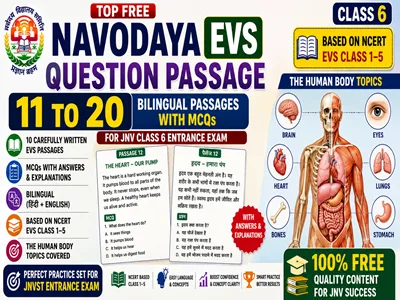
Best Free Navodaya EVS Question Passage 11 to 20 – JNV Class 6 Reading Practice (2027)
Navodaya EVS Question Passage 11 to 20 — 10 bilingual (Hindi + English) reading passages from “The Human Body” topic, each with 5 comprehension MCQs. NCERT Class 1–5 based, made for JNVST Class 6 EVS section (Q21–40) as per the new 2027 syllabus.
📅 Last Updated: 9 August 2026
अगर आप Navodaya EVS Question Passage 11 to 20 ढूँढ रहे हैं, तो आप सही जगह पर हैं। यह पेज JNVST Class 6 Entrance Exam 2027 के EVS सेक्शन (Q21–40) के लिए तैयार किया गया है, जिसमें The Human Body टॉपिक से जुड़े 10 पूरी तरह bilingual reading passages दिए गए हैं — पहले हिंदी पैराग्राफ के साथ उसके 5 हिंदी प्रश्न, फिर उसी passage का English पैराग्राफ उसके 5 English प्रश्नों के साथ। हर सवाल के नीचे 👁️ बटन दबाकर आप उसका सही उत्तर देख सकते हैं — यह Navodaya Class 6 EVS MCQ अभ्यास, JNVST Passage Questions और Navodaya EVS Practice Set 2027 तीनों का काम एक साथ करता है।
यह Navodaya EVS Question Passage 11 to 20 सीरीज खासतौर पर उन बच्चों के लिए बनाई गई है जो JNV Class 6 The Human Body Questions की प्रैक्टिस करना चाहते हैं — Food & Nutrients, Hygiene, Super Senses, Digestive System, Circulatory System, Respiratory System, Dental Hygiene, Five Sense Organs, Bones & Muscles और Sleep & Exercise जैसे सभी सब-टॉपिक इसमें कवर होते हैं। रोज 1-2 passage पढ़कर और उसके नीचे दिए Navodaya Class 6 EVS MCQ हल करके, आप JNVST Passage Questions में अपनी स्पीड और accuracy दोनों बढ़ा सकते हैं। यह पूरा Navodaya EVS Practice Set 2027 बिल्कुल मुफ्त है और आगे 100 तक के सभी passages इसी तरह जोड़े जाते रहेंगे।
- Passage 11 — संतुलित आहार (Food & Nutrients)
- Passage 12 — साफ-सफाई की आदत (Hygiene)
- Passage 13 — जानवरों की अद्भुत इंद्रियाँ (Super Senses)
- Passage 14 — भोजन का सफर (Digestive System)
- Passage 15 — दिल की धड़कन (Circulatory System)
- Passage 16 — साँस की डोर (Respiratory System)
- Passage 17 — दाँतों की देखभाल (Dental Hygiene)
- Passage 18 — हमारी पाँच इंद्रियाँ (Five Senses)
- Passage 19 — हड्डियों का ढाँचा (Bones & Muscles)
- Passage 20 — नींद और आराम (Sleep & Exercise)
- FAQs
📌 Navodaya EVS Question Passage 11 to 20 · Navodaya Class 6 EVS MCQ · JNVST Passage Questions · Navodaya EVS Practice Set 2027 · JNV Class 6 The Human Body Questions
📖 Passage 11 — संतुलित आहार (Food & Nutrients)
हमारे शरीर को स्वस्थ और मजबूत रहने के लिए हर तरह का भोजन जरूरी होता है, जिसे संतुलित आहार कहते हैं। रोटी, चावल और आलू जैसे भोजन से हमें ऊर्जा (कार्बोहाइड्रेट) मिलती है। दाल, अंडे और दूध से प्रोटीन मिलता है, जो शरीर की वृद्धि और मांसपेशियों को मजबूत बनाने में मदद करता है। हरी सब्जियाँ और फल हमें विटामिन और खनिज (मिनरल्स) देते हैं, जो बीमारियों से लड़ने में मदद करते हैं। घी और तेल से हमें वसा मिलती है, जो शरीर को गर्मी और ऊर्जा देती है। अगर हम सिर्फ एक ही तरह का भोजन खाएँ, तो शरीर में कुछ पोषक तत्वों की कमी हो सकती है, जिसे कुपोषण कहते हैं। इसलिए हमें हर दिन सभी तरह का खाना संतुलित मात्रा में खाना चाहिए।
Passage Questions (हिंदी)
- रोटी, चावल और आलू से हमें क्या मिलता है?
A) प्रोटीन B) ऊर्जा (कार्बोहाइड्रेट) C) विटामिन D) वसा
उत्तर देखें
सही उत्तर: B) ऊर्जा (कार्बोहाइड्रेट) - दाल, अंडे और दूध से क्या मिलता है?
A) प्रोटीन B) कार्बोहाइड्रेट C) पानी D) फाइबर
उत्तर देखें
सही उत्तर: A) प्रोटीन - हरी सब्जियाँ और फल हमें क्या देते हैं?
A) सिर्फ पानी B) विटामिन और खनिज C) सिर्फ वसा D) सिर्फ नमक
उत्तर देखें
सही उत्तर: B) विटामिन और खनिज - पोषक तत्वों की कमी को क्या कहते हैं?
A) पोषण B) कुपोषण C) संतुलन D) पाचन
उत्तर देखें
सही उत्तर: B) कुपोषण - हमें कैसा भोजन खाना चाहिए?
A) सिर्फ एक तरह का B) सभी तरह का, संतुलित मात्रा में C) सिर्फ मीठा D) सिर्फ तला हुआ
उत्तर देखें
सही उत्तर: B) सभी तरह का, संतुलित मात्रा में
Our body needs every kind of food to stay healthy and strong; this is called a balanced diet. Foods like roti, rice and potatoes give us energy (carbohydrates). Pulses, eggs and milk give us protein, which helps the body grow and makes muscles strong. Green vegetables and fruits give us vitamins and minerals, which help us fight diseases. Ghee and oil give us fat, which gives the body heat and energy. If we eat only one kind of food, the body may lack certain nutrients — this is called malnutrition. So we should eat all kinds of food in balanced amounts every day.
Passage Questions (English)
- What do roti, rice and potatoes give us?
A) Protein B) Energy (carbohydrates) C) Vitamins D) Fat
Show Answer
Correct Answer: B) Energy (carbohydrates) - What do pulses, eggs and milk give us?
A) Protein B) Carbohydrates C) Water D) Fibre
Show Answer
Correct Answer: A) Protein - What do green vegetables and fruits give us?
A) Only water B) Vitamins and minerals C) Only fat D) Only salt
Show Answer
Correct Answer: B) Vitamins and minerals - What is the lack of nutrients in the body called?
A) Nutrition B) Malnutrition C) Balance D) Digestion
Show Answer
Correct Answer: B) Malnutrition - What kind of food should we eat?
A) Only one kind B) All kinds, in balanced amounts C) Only sweets D) Only fried food
Show Answer
Correct Answer: B) All kinds, in balanced amounts
📖 Passage 12 — साफ-सफाई की आदत (Hygiene & Cleanliness)
अच्छी सेहत के लिए साफ-सफाई की आदतें बहुत जरूरी हैं। हमें खाना खाने से पहले और शौचालय जाने के बाद हमेशा साबुन से हाथ धोने चाहिए, क्योंकि गंदे हाथों से कीटाणु शरीर में जा सकते हैं और बीमार कर सकते हैं। रोज नहाना, नाखून काटना और साफ कपड़े पहनना भी जरूरी है। दिन में दो बार दाँत साफ करने से दाँतों में कीड़े नहीं लगते। खाँसते या छींकते समय मुँह को रूमाल या कोहनी से ढकना चाहिए, ताकि कीटाणु दूसरों तक न फैलें। घर और आस-पास की जगह को भी साफ रखना चाहिए, क्योंकि गंदगी में मच्छर और कीटाणु पनपते हैं, जिनसे मलेरिया और डेंगू जैसी बीमारियाँ फैलती हैं। साफ-सफाई से हम खुद को और दूसरों को बीमारियों से बचाते हैं।
Passage Questions (हिंदी)
- हमें हाथ कब धोने चाहिए?
A) सिर्फ सुबह B) खाना खाने से पहले और शौचालय के बाद C) सिर्फ रात में D) कभी नहीं
उत्तर देखें
सही उत्तर: B) खाना खाने से पहले और शौचालय के बाद - दिन में दो बार दाँत साफ करने से क्या होता है?
A) दाँत पीले हो जाते हैं B) दाँतों में कीड़े नहीं लगते C) दाँत टूट जाते हैं D) कुछ नहीं होता
उत्तर देखें
सही उत्तर: B) दाँतों में कीड़े नहीं लगते - खाँसते समय मुँह को क्यों ढकना चाहिए?
A) आवाज कम करने के लिए B) कीटाणुओं को फैलने से रोकने के लिए C) ठंड से बचने के लिए D) शर्म की वजह से
उत्तर देखें
सही उत्तर: B) कीटाणुओं को फैलने से रोकने के लिए - गंदगी में क्या पनपते हैं?
A) फूल B) मच्छर और कीटाणु C) पेड़ D) पानी
उत्तर देखें
सही उत्तर: B) मच्छर और कीटाणु - साफ-सफाई से क्या फायदा होता है?
A) समय बर्बाद होता है B) हम बीमारियों से बचते हैं C) कोई फायदा नहीं D) पैसे बचते हैं
उत्तर देखें
सही उत्तर: B) हम बीमारियों से बचते हैं
Habits of cleanliness are very important for good health. We should always wash our hands with soap before eating food and after using the toilet, because germs from dirty hands can enter the body and make us sick. Bathing daily, cutting nails, and wearing clean clothes are also important. Brushing teeth twice a day prevents tooth decay. While coughing or sneezing, we should cover our mouth with a handkerchief or elbow so that germs do not spread to others. We should also keep our homes and surroundings clean, because dirt allows mosquitoes and germs to breed, spreading diseases like malaria and dengue. Cleanliness protects both us and others from diseases.
Passage Questions (English)
- When should we wash our hands?
A) Only in the morning B) Before eating and after using the toilet C) Only at night D) Never
Show Answer
Correct Answer: B) Before eating and after using the toilet - What happens when we brush our teeth twice a day?
A) Teeth turn yellow B) Teeth do not decay C) Teeth break D) Nothing happens
Show Answer
Correct Answer: B) Teeth do not decay - Why should we cover our mouth while coughing?
A) To reduce noise B) To stop germs from spreading C) To avoid cold D) Out of shyness
Show Answer
Correct Answer: B) To stop germs from spreading - What breeds in dirty surroundings?
A) Flowers B) Mosquitoes and germs C) Trees D) Water
Show Answer
Correct Answer: B) Mosquitoes and germs - What is the benefit of cleanliness?
A) It wastes time B) It protects us from diseases C) No benefit D) It saves money
Show Answer
Correct Answer: B) It protects us from diseases
📖 Passage 13 — जानवरों की अद्भुत इंद्रियाँ (Super Senses)
कुछ जानवरों की इंद्रियाँ इंसानों से कहीं ज्यादा तेज होती हैं, जिन्हें सुपर सेंस कहा जाता है। कुत्ते की सूँघने की शक्ति इंसान से हजारों गुना ज्यादा तेज होती है, इसलिए उसे पुलिस बम और खोए हुए लोगों को ढूँढने के लिए इस्तेमाल करती है। उल्लू रात में भी बहुत अच्छी तरह देख सकता है, क्योंकि उसकी आँखें अंधेरे में भी रोशनी को पकड़ लेती हैं। चमगादड़ पूरी तरह अंधेरे में उड़ते हुए भी दीवारों से नहीं टकराता, क्योंकि वह आवाज की गूँज सुनकर रास्ता समझता है, इसे इकोलोकेशन कहते हैं। चींटियाँ अपने शरीर के वजन से कई गुना ज्यादा वजन उठा सकती हैं। हाथी की सूँड बहुत संवेदनशील होती है और वह इससे छोटी-छोटी चीजें भी उठा लेता है। इन अद्भुत क्षमताओं की वजह से जानवर अपने वातावरण में आसानी से जीवित रह पाते हैं।
Passage Questions (हिंदी)
- पुलिस कुत्तों का इस्तेमाल क्यों करती है?
A) उनकी तेज नजर के लिए B) उनकी तेज सूँघने की शक्ति के लिए C) उनकी तेज दौड़ के लिए D) उनकी आवाज के लिए
उत्तर देखें
सही उत्तर: B) उनकी तेज सूँघने की शक्ति के लिए - उल्लू रात में अच्छी तरह क्यों देख पाता है?
A) उसके बड़े कान होते हैं B) उसकी आँखें अंधेरे में भी रोशनी पकड़ लेती हैं C) उसकी लंबी सूँड होती है D) उसके तेज पंजे होते हैं
उत्तर देखें
सही उत्तर: B) उसकी आँखें अंधेरे में भी रोशनी पकड़ लेती हैं - चमगादड़ अंधेरे में रास्ता कैसे समझता है?
A) सूँघकर B) आवाज की गूँज सुनकर (इकोलोकेशन) C) देखकर D) चखकर
उत्तर देखें
सही उत्तर: B) आवाज की गूँज सुनकर (इकोलोकेशन) - चींटियाँ किस बात के लिए जानी जाती हैं?
A) तेज दौड़ने के लिए B) अपने वजन से कई गुना ज्यादा वजन उठाने के लिए C) उड़ने के लिए D) तैरने के लिए
उत्तर देखें
सही उत्तर: B) अपने वजन से कई गुना ज्यादा वजन उठाने के लिए - हाथी छोटी चीजें उठाने के लिए किसका इस्तेमाल करता है?
A) पैर B) सूँड C) कान D) पूँछ
उत्तर देखें
सही उत्तर: B) सूँड
Some animals have senses that are far sharper than humans; these are called super senses. A dog’s sense of smell is thousands of times sharper than a human’s, which is why the police use dogs to find bombs and missing people. An owl can see very well even at night, because its eyes can catch even the faintest light in the dark. A bat does not hit walls even while flying in complete darkness, because it understands its path by listening to echoes — this is called echolocation. Ants can lift many times their own body weight. An elephant’s trunk is very sensitive and can pick up even tiny objects. Because of these amazing abilities, animals can survive easily in their surroundings.
Passage Questions (English)
- Why do police use dogs?
A) For their sharp eyesight B) For their sharp sense of smell C) For their fast running D) For their voice
Show Answer
Correct Answer: B) For their sharp sense of smell - Why can an owl see well at night?
A) It has big ears B) Its eyes catch even faint light in the dark C) It has a long trunk D) It has sharp claws
Show Answer
Correct Answer: B) Its eyes catch even faint light in the dark - How does a bat find its way in the dark?
A) By smell B) By listening to echoes (echolocation) C) By sight D) By taste
Show Answer
Correct Answer: B) By listening to echoes (echolocation) - What are ants known for?
A) Running fast B) Lifting many times their own body weight C) Flying D) Swimming
Show Answer
Correct Answer: B) Lifting many times their own body weight - What does an elephant use to pick up small objects?
A) Legs B) Trunk C) Ears D) Tail
Show Answer
Correct Answer: B) Trunk
📖 Passage 14 — भोजन का सफर (Digestive System)
जब हम खाना खाते हैं, तो वह हमारे शरीर के अंदर एक लंबा सफर तय करता है, जिसे पाचन कहते हैं। सबसे पहले हम मुँह में खाने को दाँतों से चबाते हैं और लार उसे नरम बनाती है। फिर खाना एक नली, जिसे भोजन-नली (ग्रासनली) कहते हैं, से होकर पेट में जाता है। पेट में तेज अम्ल (एसिड) और रस खाने को छोटे-छोटे टुकड़ों में तोड़ते हैं। इसके बाद खाना छोटी आँत में जाता है, जहाँ से शरीर पोषक तत्वों को सोख लेता है और खून में भेज देता है। जो हिस्सा शरीर के काम का नहीं होता, वह बड़ी आँत में जाता है और अंत में मल के रूप में शरीर से बाहर निकल जाता है। यह पूरी प्रक्रिया शरीर को भोजन से ऊर्जा और पोषण देती है।
Passage Questions (हिंदी)
- मुँह में खाने को नरम कौन बनाता है?
A) पानी B) लार C) हवा D) खून
उत्तर देखें
सही उत्तर: B) लार - खाना मुँह से पेट तक किस रास्ते से जाता है?
A) श्वास नली B) भोजन-नली (ग्रासनली) C) रक्त वाहिका D) आँत
उत्तर देखें
सही उत्तर: B) भोजन-नली (ग्रासनली) - पेट में खाने को कौन छोटे टुकड़ों में तोड़ता है?
A) पानी B) अम्ल (एसिड) और रस C) हवा D) लार
उत्तर देखें
सही उत्तर: B) अम्ल (एसिड) और रस - शरीर पोषक तत्वों को कहाँ से सोखता है?
A) पेट से B) छोटी आँत से C) बड़ी आँत से D) मुँह से
उत्तर देखें
सही उत्तर: B) छोटी आँत से - जो भोजन शरीर के काम का नहीं होता, वह अंत में कहाँ से बाहर निकलता है?
A) मुँह से B) बड़ी आँत के रास्ते मल के रूप में C) नाक से D) कान से
उत्तर देखें
सही उत्तर: B) बड़ी आँत के रास्ते मल के रूप में
When we eat food, it travels a long journey inside our body, which is called digestion. First, we chew the food with our teeth in the mouth, and saliva makes it soft. Then the food passes through a tube called the food pipe (oesophagus) into the stomach. In the stomach, strong acid and juices break the food into tiny pieces. After that, the food goes into the small intestine, where the body absorbs nutrients and sends them into the blood. The part that the body cannot use goes into the large intestine and finally leaves the body as waste. This entire process gives the body energy and nutrition from food.
Passage Questions (English)
- What makes food soft in the mouth?
A) Water B) Saliva C) Air D) Blood
Show Answer
Correct Answer: B) Saliva - Which tube carries food from the mouth to the stomach?
A) Windpipe B) Food pipe (oesophagus) C) Blood vessel D) Intestine
Show Answer
Correct Answer: B) Food pipe (oesophagus) - What breaks food into tiny pieces in the stomach?
A) Water B) Acid and juices C) Air D) Saliva
Show Answer
Correct Answer: B) Acid and juices - From where does the body absorb nutrients?
A) Stomach B) Small intestine C) Large intestine D) Mouth
Show Answer
Correct Answer: B) Small intestine - Where does unused food finally leave the body from?
A) Mouth B) Through the large intestine as waste C) Nose D) Ears
Show Answer
Correct Answer: B) Through the large intestine as waste
📖 Passage 15 — दिल की धड़कन (Circulatory System)
हमारा दिल (हृदय) एक मजबूत मांसपेशी है, जो पूरे शरीर में खून पहुँचाने का काम करती है। यह लगातार धड़कता रहता है और बिना रुके काम करता है। दिल खून को खून की नलियों (रक्त वाहिकाओं) के जरिए शरीर के हर हिस्से में भेजता है। ये नलियाँ दो तरह की होती हैं — धमनियाँ, जो शुद्ध और ऑक्सीजन भरा खून दिल से शरीर के बाकी हिस्सों तक ले जाती हैं, और शिराएँ, जो अशुद्ध खून वापस दिल तक लाती हैं। खून शरीर के हर हिस्से तक ऑक्सीजन और पोषक तत्व पहुँचाता है और साथ ही गंदगी को बाहर निकालने में मदद करता है। हमारा दिल मुट्ठी के आकार का होता है, लेकिन यह जिंदगीभर बिना थके काम करता रहता है। दिल को स्वस्थ रखने के लिए व्यायाम करना और अच्छा खाना जरूरी है।
Passage Questions (हिंदी)
- दिल का मुख्य काम क्या है?
A) खाना पचाना B) पूरे शरीर में खून पहुँचाना C) हवा साफ करना D) सोचना
उत्तर देखें
सही उत्तर: B) पूरे शरीर में खून पहुँचाना - शुद्ध और ऑक्सीजन भरा खून किसके जरिए शरीर में जाता है?
A) शिराओं से B) धमनियों से C) पेट से D) फेफड़ों से
उत्तर देखें
सही उत्तर: B) धमनियों से - अशुद्ध खून वापस दिल तक कौन लाता है?
A) धमनियाँ B) शिराएँ C) आँतें D) फेफड़े
उत्तर देखें
सही उत्तर: B) शिराएँ - खून शरीर तक क्या पहुँचाता है?
A) सिर्फ पानी B) ऑक्सीजन और पोषक तत्व C) सिर्फ हवा D) सिर्फ नमक
उत्तर देखें
सही उत्तर: B) ऑक्सीजन और पोषक तत्व - हमारा दिल किसके आकार का होता है?
A) हथेली B) मुट्ठी C) पैर D) सिर
उत्तर देखें
सही उत्तर: B) मुट्ठी
Our heart is a strong muscle that pumps blood to the whole body. It keeps beating continuously and works without stopping. The heart sends blood to every part of the body through blood vessels. These vessels are of two types — arteries, which carry pure, oxygen-rich blood from the heart to the rest of the body, and veins, which bring impure blood back to the heart. Blood carries oxygen and nutrients to every part of the body and also helps remove waste from it. Our heart is about the size of a fist, but it keeps working tirelessly throughout our life. Exercise and good food are important to keep the heart healthy.
Passage Questions (English)
- What is the main function of the heart?
A) To digest food B) To pump blood to the whole body C) To clean air D) To think
Show Answer
Correct Answer: B) To pump blood to the whole body - Through what does pure, oxygen-rich blood travel to the body?
A) Veins B) Arteries C) Stomach D) Lungs
Show Answer
Correct Answer: B) Arteries - What brings impure blood back to the heart?
A) Arteries B) Veins C) Intestines D) Lungs
Show Answer
Correct Answer: B) Veins - What does blood carry to the body?
A) Only water B) Oxygen and nutrients C) Only air D) Only salt
Show Answer
Correct Answer: B) Oxygen and nutrients - What is the size of our heart similar to?
A) A palm B) A fist C) A foot D) A head
Show Answer
Correct Answer: B) A fist
📖 Passage 16 — साँस की डोर (Respiratory System)
साँस लेना जीवन के लिए बहुत जरूरी है और यह काम हमारे श्वसन तंत्र (respiratory system) द्वारा होता है। जब हम साँस लेते हैं, तो हवा नाक के रास्ते शरीर में जाती है और श्वास नली से होते हुए फेफड़ों तक पहुँचती है। फेफड़े हवा से ऑक्सीजन को अलग करके उसे खून में मिला देते हैं, और खून यह ऑक्सीजन पूरे शरीर तक पहुँचाता है। जब हम साँस छोड़ते हैं, तो शरीर से कार्बन डाइऑक्साइड बाहर निकल जाती है, जो शरीर के काम की नहीं होती। हमारे फेफड़े गुब्बारे की तरह फूलते और सिकुड़ते हैं, जिससे हवा अंदर-बाहर होती रहती है। एक स्वस्थ इंसान एक मिनट में लगभग 12 से 16 बार साँस लेता है। फेफड़ों को स्वस्थ रखने के लिए धुएँ और प्रदूषण से बचना जरूरी है।
Passage Questions (हिंदी)
- हवा नाक से होकर कहाँ पहुँचती है?
A) पेट B) फेफड़े C) दिल D) आँतें
उत्तर देखें
सही उत्तर: B) फेफड़े - फेफड़े हवा से क्या अलग करते हैं?
A) कार्बन डाइऑक्साइड B) ऑक्सीजन C) नाइट्रोजन D) धुआँ
उत्तर देखें
सही उत्तर: B) ऑक्सीजन - साँस छोड़ने पर शरीर से क्या बाहर निकलती है?
A) ऑक्सीजन B) कार्बन डाइऑक्साइड C) पानी D) नमक
उत्तर देखें
सही उत्तर: B) कार्बन डाइऑक्साइड - हमारे फेफड़े किसकी तरह फूलते-सिकुड़ते हैं?
A) पत्थर B) गुब्बारा C) लोहा D) काँच
उत्तर देखें
सही उत्तर: B) गुब्बारा - फेफड़ों को स्वस्थ रखने के लिए क्या जरूरी है?
A) धुएँ और प्रदूषण से बचना B) ज्यादा मीठा खाना C) कम पानी पीना D) कम सोना
उत्तर देखें
सही उत्तर: A) धुएँ और प्रदूषण से बचना
Breathing is very important for life, and this work is done by our respiratory system. When we breathe in, air enters the body through the nose and travels through the windpipe to reach the lungs. The lungs separate oxygen from the air and mix it into the blood, and the blood carries this oxygen throughout the body. When we breathe out, carbon dioxide, which the body does not need, leaves the body. Our lungs expand and shrink like balloons, letting air move in and out. A healthy person breathes about 12 to 16 times a minute. It is important to avoid smoke and pollution to keep the lungs healthy.
Passage Questions (English)
- Where does air reach after entering through the nose?
A) Stomach B) Lungs C) Heart D) Intestines
Show Answer
Correct Answer: B) Lungs - What do the lungs separate from the air?
A) Carbon dioxide B) Oxygen C) Nitrogen D) Smoke
Show Answer
Correct Answer: B) Oxygen - What leaves the body when we breathe out?
A) Oxygen B) Carbon dioxide C) Water D) Salt
Show Answer
Correct Answer: B) Carbon dioxide - What do our lungs expand and shrink like?
A) Stone B) Balloon C) Iron D) Glass
Show Answer
Correct Answer: B) Balloon - What is important to keep the lungs healthy?
A) Avoiding smoke and pollution B) Eating more sweets C) Drinking less water D) Sleeping less
Show Answer
Correct Answer: A) Avoiding smoke and pollution
📖 Passage 17 — दाँतों की देखभाल (Teeth & Dental Hygiene)
हमारे दाँत खाना चबाने और साफ बोलने में मदद करते हैं। एक इंसान के जीवन में दो बार दाँत आते हैं — पहले दूध के दाँत, जो बचपन में आते हैं और बाद में गिर जाते हैं, फिर स्थायी दाँत, जो जीवन भर साथ रहते हैं। दाँतों के अलग-अलग प्रकार अलग-अलग काम करते हैं — आगे के कटर दाँत खाने को काटते हैं, नुकीले दाँत खाने को फाड़ते हैं, और पीछे के चौड़े दाँत खाने को पीसते हैं। ज्यादा मीठा खाने और दाँत साफ न करने से दाँतों में कीड़ा लग सकता है, जिससे दर्द होता है। दिन में दो बार ब्रश करना, ज्यादा मीठा न खाना और साल में एक-दो बार डॉक्टर को दिखाना दाँतों को स्वस्थ रखने के अच्छे तरीके हैं।
Passage Questions (हिंदी)
- इंसान के जीवन में कितनी बार दाँत आते हैं?
A) एक बार B) दो बार C) तीन बार D) चार बार
उत्तर देखें
सही उत्तर: B) दो बार - बचपन में आने वाले दाँतों को क्या कहते हैं?
A) स्थायी दाँत B) दूध के दाँत C) नकली दाँत D) कटर दाँत
उत्तर देखें
सही उत्तर: B) दूध के दाँत - खाने को काटने का काम कौन-से दाँत करते हैं?
A) आगे के कटर दाँत B) नुकीले दाँत C) पीछे के चौड़े दाँत D) कोई नहीं
उत्तर देखें
सही उत्तर: A) आगे के कटर दाँत - दाँतों में कीड़ा किस वजह से लगता है?
A) ज्यादा पानी पीने से B) ज्यादा मीठा खाने और साफ न करने से C) ज्यादा सोने से D) ज्यादा दौड़ने से
उत्तर देखें
सही उत्तर: B) ज्यादा मीठा खाने और साफ न करने से - दाँतों को स्वस्थ रखने का एक अच्छा तरीका क्या है?
A) दिन में दो बार ब्रश करना B) कभी ब्रश न करना C) सिर्फ मीठा खाना D) डॉक्टर से न मिलना
उत्तर देखें
सही उत्तर: A) दिन में दो बार ब्रश करना
Our teeth help us chew food and speak clearly. A person gets teeth twice in life — first milk teeth, which come in childhood and later fall out, and then permanent teeth, which stay for the rest of life. Different types of teeth do different jobs — the front cutting teeth cut food, the pointed teeth tear food, and the wide back teeth grind food. Eating too much sugar and not cleaning teeth can cause tooth decay, which leads to pain. Brushing twice a day, avoiding too much sugar, and visiting a doctor once or twice a year are good ways to keep teeth healthy.
Passage Questions (English)
- How many times does a person get teeth in life?
A) Once B) Twice C) Three times D) Four times
Show Answer
Correct Answer: B) Twice - What are the teeth that come in childhood called?
A) Permanent teeth B) Milk teeth C) Fake teeth D) Cutting teeth
Show Answer
Correct Answer: B) Milk teeth - Which teeth cut food?
A) Front cutting teeth B) Pointed teeth C) Back wide teeth D) None
Show Answer
Correct Answer: A) Front cutting teeth - What causes tooth decay?
A) Drinking too much water B) Eating too much sugar and not cleaning teeth C) Sleeping too much D) Running too much
Show Answer
Correct Answer: B) Eating too much sugar and not cleaning teeth - What is a good way to keep teeth healthy?
A) Brushing twice a day B) Never brushing C) Eating only sweets D) Never visiting a doctor
Show Answer
Correct Answer: A) Brushing twice a day
📖 Passage 18 — हमारी पाँच इंद्रियाँ (Five Sense Organs)
हमारा शरीर पाँच इंद्रियों की मदद से आस-पास की दुनिया को महसूस करता है। आँखें हमें देखने में मदद करती हैं, कान हमें सुनने में मदद करते हैं, नाक हमें सूँघने में मदद करती है, जीभ हमें स्वाद पहचानने में मदद करती है, और त्वचा (skin) हमें छूने पर गर्मी, ठंडक और दर्द महसूस कराती है। ये सभी इंद्रियाँ मिलकर हमारे मस्तिष्क को जानकारी भेजती हैं, और मस्तिष्क उस जानकारी को समझकर हमें बताता है कि हमारे आस-पास क्या हो रहा है। अगर हमारी कोई एक इंद्री कमजोर हो, तो दूसरी इंद्रियाँ ज्यादा तेज हो जाती हैं, जैसे नेत्रहीन लोगों के कान और स्पर्श की समझ बहुत तेज होती है। इसलिए हमें अपनी इंद्रियों की देखभाल करनी चाहिए, जैसे तेज धूप में आँखों को बचाना और तेज आवाज से कानों को बचाना।
Passage Questions (हिंदी)
- हमें देखने में कौन-सी इंद्री मदद करती है?
A) कान B) आँखें C) नाक D) जीभ
उत्तर देखें
सही उत्तर: B) आँखें - स्वाद पहचानने में कौन-सी इंद्री मदद करती है?
A) आँखें B) जीभ C) त्वचा D) कान
उत्तर देखें
सही उत्तर: B) जीभ - सारी इंद्रियों से जानकारी कहाँ जाती है?
A) पेट में B) मस्तिष्क में C) हड्डियों में D) फेफड़ों में
उत्तर देखें
सही उत्तर: B) मस्तिष्क में - नेत्रहीन लोगों की कौन-सी इंद्रियाँ ज्यादा तेज होती हैं?
A) आँखें B) सुनना और छूना C) सूँघना कम होता है D) कोई भी नहीं
उत्तर देखें
सही उत्तर: B) सुनना और छूना - तेज धूप और तेज आवाज से हमें किसकी रक्षा करनी चाहिए?
A) दाँत और नाक B) आँखें और कान C) हाथ और पैर D) बाल और नाखून
उत्तर देखें
सही उत्तर: B) आँखें और कान
Our body senses the world around us with the help of five sense organs. Eyes help us see, ears help us hear, the nose helps us smell, the tongue helps us recognise taste, and the skin lets us feel heat, cold and pain through touch. All these senses send information to our brain, and the brain understands this information and tells us what is happening around us. If one of our senses is weak, the other senses often become sharper — for example, blind people often have a very sharp sense of hearing and touch. So we should take care of our senses, such as protecting our eyes from bright sunlight and our ears from loud noise.
Passage Questions (English)
- Which sense organ helps us see?
A) Ears B) Eyes C) Nose D) Tongue
Show Answer
Correct Answer: B) Eyes - Which sense organ helps recognise taste?
A) Eyes B) Tongue C) Skin D) Ears
Show Answer
Correct Answer: B) Tongue - Where does information from all senses go?
A) Stomach B) Brain C) Bones D) Lungs
Show Answer
Correct Answer: B) Brain - Which senses become sharper in blind people?
A) Eyes B) Hearing and touch C) Smell decreases D) None
Show Answer
Correct Answer: B) Hearing and touch - What should we protect from bright sunlight and loud noise?
A) Teeth and nose B) Eyes and ears C) Hands and feet D) Hair and nails
Show Answer
Correct Answer: B) Eyes and ears
📖 Passage 19 — हड्डियों का ढाँचा (Bones & Muscles)
हमारे शरीर के अंदर हड्डियों का एक मजबूत ढाँचा होता है, जिसे कंकाल (skeleton) कहते हैं। कंकाल शरीर को आकार देता है, हमें सीधा खड़ा रहने में मदद करता है और दिल व फेफड़ों जैसे नाजुक अंगों की रक्षा करता है। एक वयस्क इंसान के शरीर में लगभग 206 हड्डियाँ होती हैं, लेकिन बच्चों में इससे ज्यादा होती हैं क्योंकि कुछ हड्डियाँ बड़े होने पर आपस में जुड़ जाती हैं। हड्डियों को हिलाने का काम मांसपेशियाँ (muscles) करती हैं, जो हड्डियों से जुड़ी होती हैं और सिकुड़-फैलकर हमें चलने, दौड़ने और उठाने में मदद करती हैं। हड्डियों को मजबूत रखने के लिए दूध और कैल्शियम वाला भोजन खाना जरूरी है, और मांसपेशियों को मजबूत रखने के लिए रोज व्यायाम करना चाहिए।
Passage Questions (हिंदी)
- शरीर के हड्डियों के ढाँचे को क्या कहते हैं?
A) मांसपेशी B) कंकाल C) त्वचा D) रक्त
उत्तर देखें
सही उत्तर: B) कंकाल - एक वयस्क इंसान के शरीर में लगभग कितनी हड्डियाँ होती हैं?
A) 106 B) 206 C) 306 D) 406
उत्तर देखें
सही उत्तर: B) 206 - बच्चों में वयस्कों से ज्यादा हड्डियाँ क्यों होती हैं?
A) वे ज्यादा खाते हैं B) कुछ हड्डियाँ बड़े होने पर आपस में जुड़ जाती हैं C) वे कमजोर होते हैं D) कोई कारण नहीं
उत्तर देखें
सही उत्तर: B) कुछ हड्डियाँ बड़े होने पर आपस में जुड़ जाती हैं - हड्डियों को हिलाने का काम कौन करता है?
A) त्वचा B) मांसपेशियाँ C) खून D) बाल
उत्तर देखें
सही उत्तर: B) मांसपेशियाँ - हड्डियों को मजबूत रखने के लिए क्या खाना चाहिए?
A) सिर्फ चीनी B) दूध और कैल्शियम वाला भोजन C) सिर्फ पानी D) सिर्फ नमक
उत्तर देखें
सही उत्तर: B) दूध और कैल्शियम वाला भोजन
Inside our body, there is a strong framework of bones, called the skeleton. The skeleton gives shape to the body, helps us stand upright, and protects delicate organs like the heart and lungs. An adult human body has about 206 bones, but children have more, because some bones join together as they grow up. Muscles are attached to the bones and do the work of moving them; they contract and stretch to help us walk, run and lift things. To keep bones strong, it is important to eat milk and calcium-rich food, and to keep muscles strong, we should exercise daily.
Passage Questions (English)
- What is the bone framework of the body called?
A) Muscle B) Skeleton C) Skin D) Blood
Show Answer
Correct Answer: B) Skeleton - How many bones does an adult human body have approximately?
A) 106 B) 206 C) 306 D) 406
Show Answer
Correct Answer: B) 206 - Why do children have more bones than adults?
A) They eat more B) Some bones join together as they grow up C) They are weak D) No reason
Show Answer
Correct Answer: B) Some bones join together as they grow up - What does the work of moving bones?
A) Skin B) Muscles C) Blood D) Hair
Show Answer
Correct Answer: B) Muscles - What should be eaten to keep bones strong?
A) Only sugar B) Milk and calcium-rich food C) Only water D) Only salt
Show Answer
Correct Answer: B) Milk and calcium-rich food
📖 Passage 20 — नींद और आराम (Sleep & Exercise)
शरीर को स्वस्थ रखने के लिए भरपूर नींद और रोज व्यायाम करना बहुत जरूरी है। बच्चों को हर दिन कम से कम 9 से 11 घंटे की नींद लेनी चाहिए, क्योंकि नींद के दौरान शरीर आराम करता है और मस्तिष्क दिनभर की सीखी हुई बातों को याद रखने का काम करता है। पूरी नींद न लेने से बच्चे थके-थके और चिड़चिड़े रहते हैं और उनका पढ़ाई में मन नहीं लगता। इसके साथ ही रोज कुछ समय दौड़ना, खेलना या व्यायाम करना भी जरूरी है, क्योंकि इससे मांसपेशियाँ और हड्डियाँ मजबूत होती हैं और शरीर में ऊर्जा बनी रहती है। बहुत ज्यादा समय मोबाइल फोन या टीवी देखने में बिताने से शरीर को पर्याप्त हलचल नहीं मिलती, जिससे मोटापे जैसी समस्याएँ हो सकती हैं। इसलिए सही नींद और रोज खेलकूद एक स्वस्थ जीवन के लिए जरूरी हैं।
Passage Questions (हिंदी)
- बच्चों को रोज कितने घंटे की नींद लेनी चाहिए?
A) 3 से 5 घंटे B) 9 से 11 घंटे C) 15 घंटे D) 1 घंटा
उत्तर देखें
सही उत्तर: B) 9 से 11 घंटे - नींद के दौरान मस्तिष्क क्या करता है?
A) कुछ नहीं करता B) दिनभर सीखी बातें याद रखने का काम करता है C) सो जाता है D) बढ़ता है
उत्तर देखें
सही उत्तर: B) दिनभर सीखी बातें याद रखने का काम करता है - पूरी नींद न लेने से बच्चों को क्या होता है?
A) वे खुश रहते हैं B) वे थके और चिड़चिड़े रहते हैं C) वे ज्यादा तेज दौड़ते हैं D) कुछ नहीं होता
उत्तर देखें
सही उत्तर: B) वे थके और चिड़चिड़े रहते हैं - व्यायाम करने से क्या मजबूत होता है?
A) मांसपेशियाँ और हड्डियाँ B) सिर्फ बाल C) सिर्फ नाखून D) कुछ नहीं
उत्तर देखें
सही उत्तर: A) मांसपेशियाँ और हड्डियाँ - ज्यादा मोबाइल या टीवी देखने से क्या समस्या हो सकती है?
A) पढ़ाई तेज होती है B) मोटापे जैसी समस्याएँ C) आँखें तेज होती हैं D) कोई समस्या नहीं
उत्तर देखें
सही उत्तर: B) मोटापे जैसी समस्याएँ
Getting enough sleep and doing exercise every day are very important to keep the body healthy. Children should sleep at least 9 to 11 hours every day, because during sleep the body rests and the brain works to remember things learnt during the day. Not getting enough sleep makes children tired and irritable, and they cannot focus on studies. Along with this, running, playing or exercising for some time daily is also important, because it makes muscles and bones strong and keeps the body full of energy. Spending too much time watching mobile phones or TV does not give the body enough movement, which can lead to problems like obesity. So proper sleep and daily play are important for a healthy life.
Passage Questions (English)
- How many hours should children sleep every day?
A) 3 to 5 hours B) 9 to 11 hours C) 15 hours D) 1 hour
Show Answer
Correct Answer: B) 9 to 11 hours - What does the brain do during sleep?
A) Nothing B) Works to remember things learnt during the day C) Goes to sleep D) Grows
Show Answer
Correct Answer: B) Works to remember things learnt during the day - What happens to children if they don’t get enough sleep?
A) They stay happy B) They become tired and irritable C) They run faster D) Nothing happens
Show Answer
Correct Answer: B) They become tired and irritable - What becomes strong through exercise?
A) Muscles and bones B) Only hair C) Only nails D) Nothing
Show Answer
Correct Answer: A) Muscles and bones - What problem can too much mobile or TV watching cause?
A) Faster studies B) Problems like obesity C) Sharper eyes D) No problem
Show Answer
Correct Answer: B) Problems like obesity
❓ Navodaya EVS Question Passage 11 to 20 — अक्सर पूछे जाने वाले सवाल (FAQs)
Navodaya EVS Question Passage 11 to 20 में कौन-कौन से topics शामिल हैं?
इन 10 passages में “The Human Body” टॉपिक के अंतर्गत Food & Nutrients, Hygiene, Super Senses, Digestive System, Circulatory System, Respiratory System, Dental Hygiene, Five Sense Organs, Bones & Muscles, और Sleep & Exercise कवर किए गए हैं — कुल 50 bilingual MCQs के साथ।
क्या ये passages JNVST Class 6 EVS सेक्शन के पैटर्न पर आधारित हैं?
हाँ, ये सभी passages JNVST Class 6 के EVS सेक्शन (Q21–40) के लिए बनाए गए हैं, जिसमें 15 MCQs के साथ एक reading passage (5 questions सहित) पूछा जाता है। यह content NCERT Class 1–5 EVS किताबों पर आधारित है और 2027 के नए syllabus से मेल खाता है।
क्या ये passages हिंदी और English दोनों भाषाओं में उपलब्ध हैं?
जी हाँ, हर passage में पहले हिंदी पैराग्राफ और उसके 5 हिंदी प्रश्न साथ में दिए गए हैं, फिर उसी passage का English पैराग्राफ और उसके 5 English प्रश्न अलग से दिए गए हैं, ताकि दोनों भाषाओं के विद्यार्थी आसानी से अभ्यास कर सकें।
क्या Passage 1 to 10 भी उपलब्ध हैं?
हाँ, “The Natural World” टॉपिक के 10 passages पहले batch में उपलब्ध हैं — Navodaya EVS Question Passage 1 to 10 पेज देखें।
Navodaya Class 6 EVS की और तैयारी सामग्री कहाँ मिलेगी?
पूरे syllabus, mock tests, practice sets और previous year papers के लिए Navodaya Class 6 Syllabus 2027 और Free Mock Test पेज देखें।