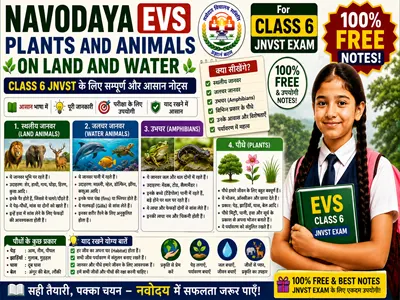
🌍 Navodaya EVS Plants and Animals on Land and Water — Class 6 JNVST Notes
Navodaya EVS Plants and Animals on Land and Water ki poori jaankari — land animals, water animals, amphibians aur plants — aasan Hindi + English bullet points mein! 🐾
Namaste Students! 👋 Agar aap Navodaya Class 6 JNVST 2026–27 ki taiyari kar rahe ho, to Navodaya EVS Plants and Animals on Land and Water topic bahut important hai. Yeh EVS The Natural World section ka hissa hai aur is topic se har saal exam mein questions poochhe jaate hain. Neeche diye gaye Navodaya EVS Plants and Animals on Land and Water notes bilkul saral bhasha mein hain, taaki Class 5 ka bachcha bhi aasani se samajh sake. Chaliye shuru karte hain! 🚀
📚 Is Page Mein Kya Hai (Table of Contents)
🏡 निवास स्थान क्या है — What is a Habitat?
- सभी जीवों को रहने, भोजन पाने और बड़े होने के लिए एक जगह चाहिए — इसे निवास स्थान (Habitat) कहते हैं — Every living thing needs a place to live, called a Habitat.
- कुछ जीव स्थल (धरती) पर रहते हैं, कुछ जल में, और कुछ दोनों जगह — Some live on land, some in water, and some in both.
🐕 स्थलीय जानवर — Land Animals
- धरती पर रहने वाले जानवर फेफड़ों (Lungs) से साँस लेते हैं और चलने के लिए पैर होते हैं — Land animals breathe using lungs and have legs to walk.
- उदाहरण: कुत्ता, गाय, शेर, हाथी, घोड़ा, बकरी, ऊँट, बाघ, हिरण, खरगोश — Examples: dog, cow, lion, elephant, horse, goat, camel, tiger, deer, rabbit.
- ऊँट को “रेगिस्तान का जहाज़” कहा जाता है — Camel is called the “Ship of the Desert”.
- हाथी सबसे बड़ा स्थलीय जानवर है, और शेर को “जंगल का राजा” कहते हैं — Elephant is the largest land animal; Lion is the “King of the Jungle”.
🐟 जलीय जानवर — Water Animals
- जल में रहने वाले जानवर गलफड़ों (Gills) से साँस लेते हैं और पंखों (Fins) से तैरते हैं — Water animals breathe using gills and swim using fins.
- उदाहरण: मछली, व्हेल, डॉल्फिन, ऑक्टोपस, केकड़ा, स्टारफिश, जेलीफिश, शार्क, झींगा — Examples: fish, whale, dolphin, octopus, crab, starfish, jellyfish, shark, prawn.
- व्हेल सबसे बड़ा जलीय जानवर है, पर यह मछली नहीं, स्तनधारी (Mammal) है — Whale is the largest water animal, but it’s a mammal, not a fish.
- मछली पानी के बाहर ज़्यादा देर नहीं रह सकती क्योंकि उसे गलफड़ों के लिए पानी चाहिए — Fish can’t survive long out of water since gills need water.
🐸 उभयचर जानवर — Animals Living on Both Land and Water
- स्थल और जल दोनों में रहने वाले जानवरों को उभयचर (Amphibians) कहते हैं — Animals living on both land and water are called Amphibians.
- उदाहरण: मेंढक, टोड, कछुआ, मगरमच्छ, और बत्तख जैसे पक्षी भी दोनों जगह रहते हैं — Examples: frog, toad, turtle, crocodile, and ducks too.
- मेंढक पानी में अंडे देते हैं, पर बड़ा मेंढक धरती पर भी उछल-कूद कर सकता है — Frogs lay eggs in water, but grown frogs hop on land too.
- मेंढक के बच्चे को टैडपोल (Tadpole) कहते हैं, जो पहले पानी में रहता है — A baby frog is called a Tadpole.
🌳 स्थलीय पौधे — Land Plants
- धरती पर उगने वाले पौधों की जड़ें मज़बूत होती हैं जो उन्हें मिट्टी में पकड़े रखती हैं — Land plants have strong roots to hold them in soil.
- उदाहरण: आम का पेड़, नीम का पेड़, गुलाब, तुलसी, गेहूँ, घास, बरगद का पेड़ — Examples: mango tree, neem tree, rose, tulsi, wheat, grass, banyan tree.
- आम का पेड़ हमें “फलों का राजा” आम देता है, और नीम की पत्तियाँ औषधीय होती हैं — Mango is the “King of Fruits”; Neem leaves are medicinal.
🪷 जलीय पौधे — Water Plants
- तैरने वाले पौधे (पत्तियाँ पानी पर तैरती हैं): कमल (Lotus), वॉटर लिली — Floating plants: Lotus, Water Lily.
- पूरी तरह पानी में डूबे रहने वाले पौधे: हाइड्रिला (Hydrilla) — Fully underwater plants: Hydrilla.
- स्वतंत्र रूप से तैरने वाले पौधे: जल कुंभी (Water Hyacinth) — Free-floating plants: Water Hyacinth.
- कमल भारत का राष्ट्रीय फूल है और तालाबों में उगता है — Lotus is India’s national flower and grows in ponds.
⚡ Navodaya EVS Plants and Animals — Quick Facts Strip
📌 Source & further reading (Govt. of India): Zoological Survey of India (ZSI)
🎯 Ab practice karo Navodaya EVS Plants and Animals ke 100+ MCQs ke saath — bilkul FREE!
📝 Free Mock Test 📄 Previous Year Papers🔗 Navodaya Class 6 — Other Important Pages
❓ Navodaya EVS Plants and Animals on Land and Water — FAQs
Navodaya Class 6 EVS mein Plants and Animals topic se kitne questions aate hain?
Navodaya Class 6 EVS ke The Natural World section mein Plants and Animals on Land and Water se aksar 1-2 direct questions poochhe jaate hain, isliye Navodaya EVS Plants and Animals on Land and Water notes achhi tarah yaad karna zaroori hai.
Land animals aur water animals kaise saans lete hain?
Land animals fefdon (lungs) se saans lete hain, jabki water animals jaise machli galfadon (gills) se saans leti hain — yeh JNVST Plants and Animals Questions mein sabse zyada poocha jaane wala fact hai.
Amphibian kise kehte hain?
Woh jaanwar jo sthal aur jal dono jagah reh sakte hain unhe Amphibians (ubhaychar) kehte hain, jaise mendhak, toad aur kachhua.
Navodaya EVS Practice Set 2027 kahan se milega?
Iss page ke upar diye gaye “Free Mock Test” aur “Previous Year Papers” buttons se aap Navodaya EVS Practice Set 2027 aur JNV Class 6 The Natural World Questions free mein practice kar sakte hain.
📅 Last Updated: 10 August 2026 | JNV Classes — jnvclasses.com