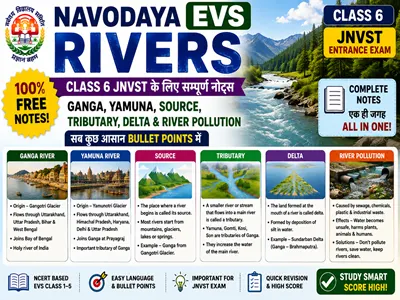
🌊 Navodaya EVS Rivers — Class 6 JNVST Notes
Navodaya EVS Rivers ki poori jaankari — source, tributary, delta, major Indian rivers aur river pollution — aasan Hindi + English bullet points mein! 🇮🇳
Namaste Students! 👋 Agar aap Navodaya Class 6 JNVST 2026–27 ki taiyari kar rahe ho, to Navodaya EVS Rivers topic bahut important hai. Yeh EVS The Natural World section ka hissa hai aur is topic se har saal exam mein questions poochhe jaate hain. Neeche diye gaye Navodaya EVS Rivers notes bilkul saral bhasha mein hain, taaki Class 5 ka bachcha bhi aasani se samajh sake. Chaliye shuru karte hain! 🚀
📚 Is Page Mein Kya Hai (Table of Contents)
🌊 नदी की मूल बातें — River Basics
- नदी पानी की एक बड़ी, प्राकृतिक धारा है जो ऊँचे से नीचे बहती है और समुद्र/झील में मिलती है — A river is a large stream flowing from a higher to a lower place, finally meeting a sea or lake.
- नदी जहाँ से शुरू होती है, उसे उद्गम (Source) कहते हैं — अक्सर पहाड़ों में बर्फ पिघलने से — The starting point is called the Source, often melting snow in mountains.
- छोटी धाराएँ जो बड़ी नदी में मिलती हैं, उन्हें सहायक नदी (Tributary) कहते हैं — Small streams joining a big river are called Tributaries.
- नदी जहाँ समुद्र से मिलती है, उसे मुहाना (Mouth) कहते हैं, यहाँ अक्सर डेल्टा बनता है — Where a river meets the sea is its Mouth, often forming a Delta.
- दो नदियों के मिलने की जगह को संगम (Confluence) कहते हैं — Where two rivers meet is called a Confluence.
🗺️ भारत की प्रमुख नदियाँ — Major Rivers of India
- गंगा (Ganga) — भारत की सबसे लंबी और सबसे पवित्र नदी, गौमुख (हिमालय) से निकलती है — India’s longest and most sacred river, originates at Gaumukh, Himalayas.
- यमुना (Yamuna) — दिल्ली व आगरा से बहती है, गंगा की प्रमुख सहायक नदी — Flows through Delhi & Agra; a major tributary of the Ganga.
- ब्रह्मपुत्र (Brahmaputra) — पूर्वोत्तर भारत की सबसे बड़ी नदी — The largest river of Northeast India.
- गोदावरी (Godavari) — इसे “दक्षिण की गंगा” कहा जाता है — Called the “Ganga of the South”.
- कावेरी (Kaveri) — कर्नाटक व तमिलनाडु से बहती है — Flows through Karnataka and Tamil Nadu.
- नर्मदा (Narmada) — गुजरात से बहती है, अरब सागर में गिरती है (बंगाल की खाड़ी में नहीं) — Flows through Gujarat into the Arabian Sea.
🚿 नदी के उपयोग — Uses of Rivers
- पीने का पानी — लोगों, जानवरों और पौधों के लिए — Drinking water for people, animals, and plants.
- सिंचाई (Irrigation) — फसलों और खेतों को पानी देना — Watering farms and crops.
- परिवहन (Transport) — नावों और जहाज़ों से सामान व लोग ले जाना — Carrying goods and people by boats/ships.
- मछली पकड़ना (Fishing) — भोजन के लिए — Catching fish for food.
- बिजली बनाना — नदियों पर बने बाँधों (Dams) से जलविद्युत बनती है — Hydroelectric power from dams on rivers.
🛕 नदी किनारे संस्कृति — River Cities & Culture
- वाराणसी, दिल्ली, कोलकाता, प्रयागराज जैसे बड़े शहर नदियों के किनारे बसे हैं — Big cities like Varanasi, Delhi, Kolkata, Prayagraj are on riverbanks.
- नदी किनारे बनी सीढ़ियों को घाट (Ghats) कहते हैं — स्नान व प्रार्थना के लिए — Steps along a riverbank are called Ghats, used for bathing and prayers.
- गंगा-यमुना (व सरस्वती) के संगम पर प्रयागराज में कुंभ मेला लगता है — The Kumbh Mela is held at the Ganga-Yamuna confluence in Prayagraj.
- प्राचीन सभ्यताएँ (जैसे सिंधु घाटी सभ्यता) नदियों के किनारे विकसित हुईं — Ancient civilizations, like the Indus Valley Civilization, grew along riverbanks.
🌱 नदी प्रदूषण व संरक्षण — River Pollution & Conservation
- कूड़ा-कचरा, रसायन और गंदा पानी (सीवेज) डालने से नदियाँ प्रदूषित होती हैं — Garbage, chemicals, and sewage pollute rivers.
- प्रदूषित पानी लोगों, मछलियों और जानवरों के लिए हानिकारक होता है — Polluted water is harmful for people, fish, and animals.
- कारखानों का गंदा पानी नदी में डालने से पहले उसे साफ (treat) किया जाना चाहिए — Factory waste water should be treated before release.
- गंगा को साफ करने के लिए सरकार का विशेष अभियान “नमामि गंगे” (Namami Gange) चल रहा है — The government’s special mission to clean the Ganga is “Namami Gange”.
- भारी बारिश से नदी किनारों से बाहर बहने को बाढ़ (Flood) कहते हैं; लंबे समय पानी न मिलने को सूखा (Drought) कहते हैं — A river overflowing is a Flood; lack of water for long is a Drought.
⚡ Navodaya EVS Rivers — Quick Facts Strip
📌 Source & further reading (Govt. of India): National Mission for Clean Ganga (Namami Gange)
🎯 Ab practice karo Navodaya EVS Rivers ke 100+ MCQs ke saath — bilkul FREE!
📝 Free Mock Test 📄 Previous Year Papers🔗 Navodaya Class 6 — Other Important Pages
❓ Navodaya EVS Rivers — FAQs
Navodaya Class 6 EVS mein Rivers topic se kitne questions aate hain?
Navodaya Class 6 EVS ke The Natural World section mein Rivers se aksar 1-2 direct questions poochhe jaate hain, isliye Navodaya EVS Rivers notes achhi tarah yaad karna zaroori hai.
Ganga nadi kahan se shuru hoti hai?
Ganga nadi Himalaya mein Gaumukh naamak sthaan se ek glacier ke pighalne se shuru hoti hai, aur Bay of Bengal mein jaakar milti hai — yeh JNVST Rivers Questions mein sabse zyada poocha jaane wala fact hai.
Tributary aur Delta mein kya antar hai?
Tributary (sahayak nadi) choti dhaara hai jo badi nadi mein milti hai, jabki Delta woh trikoniya bhoomi hai jo nadi ke samudra se milne ki jagah (mouth) par bantee hai.
Navodaya EVS Practice Set 2027 kahan se milega?
Iss page ke upar diye gaye “Free Mock Test” aur “Previous Year Papers” buttons se aap Navodaya EVS Practice Set 2027 aur JNV Class 6 The Natural World Questions free mein practice kar sakte hain.
📅 Last Updated: 10 August 2026 | JNV Classes — jnvclasses.com