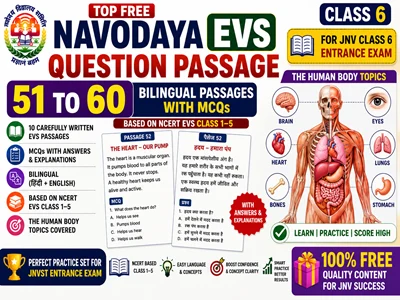
Best Free Navodaya EVS Question Passage 51 to 60 – JNV Class 6 Reading Practice (2027)
Navodaya EVS Question Passage 51 to 60 — 10 bilingual (Hindi + English) reading passages from “The Human Body” topic (round 2), each with 5 comprehension MCQs. NCERT Class 1–5 based, made for JNVST Class 6 EVS section (Q21–40) as per the new 2027 syllabus.
📅 Last Updated: 9 August 2026
अगर आप Navodaya EVS Question Passage 51 to 60 ढूँढ रहे हैं, तो आप सही जगह पर हैं। यह पेज JNVST Class 6 Entrance Exam 2027 के EVS सेक्शन (Q21–40) के लिए तैयार किया गया है, जिसमें The Human Body टॉपिक से जुड़े 10 और नए bilingual reading passages दिए गए हैं — पहले हिंदी पैराग्राफ के साथ उसके 5 हिंदी प्रश्न, फिर उसी passage का English पैराग्राफ उसके 5 English प्रश्नों के साथ। हर सवाल के नीचे 👁️ बटन दबाकर आप उसका सही उत्तर देख सकते हैं — यह Navodaya Class 6 EVS MCQ अभ्यास, JNVST Passage Questions और Navodaya EVS Practice Set 2027 तीनों का काम एक साथ करता है।
यह Navodaya EVS Question Passage 51 to 60 सीरीज खासतौर पर उन बच्चों के लिए बनाई गई है जो JNV Class 6 The Human Body Questions की गहराई से प्रैक्टिस करना चाहते हैं — Milk & Nutrients, Handwashing & Germs, Insect Super Senses, Digestive Journey Detail, Pulse, Yawning & Hiccups, Teeth Types, The Eye, Bone Healing/Fractures, और Exercise & Physical Activity जैसे नए sub-topics इसमें कवर होते हैं। रोज 1-2 passage पढ़कर और उसके नीचे दिए Navodaya Class 6 EVS MCQ हल करके, आप JNVST Passage Questions में अपनी स्पीड और accuracy दोनों बढ़ा सकते हैं। यह पूरा Navodaya EVS Practice Set 2027 बिल्कुल मुफ्त है और आगे 100 तक के सभी passages इसी तरह जोड़े जाते रहेंगे।
- Passage 51 — दूध पीने वाला बच्चा (Milk & Nutrients)
- Passage 52 — कीटाणुओं से बचाव (Handwashing & Germs)
- Passage 53 — चींटी की ताकत और मधुमक्खी (Super Senses)
- Passage 54 — जीभ का सफर (Digestive System)
- Passage 55 — नाड़ी की धड़कन (Pulse)
- Passage 56 — जम्हाई क्यों आती है (Yawning & Hiccups)
- Passage 57 — मुस्कान के पीछे की मेहनत (Teeth)
- Passage 58 — आँख का जादू (The Eye)
- Passage 59 — टूटी हड्डी और मरम्मत (Bone Healing)
- Passage 60 — खेल का मैदान (Exercise)
- FAQs
📌 Navodaya EVS Question Passage 51 to 60 · Navodaya Class 6 EVS MCQ · JNVST Passage Questions · Navodaya EVS Practice Set 2027 · JNV Class 6 The Human Body Questions
📖 Passage 51 — दूध पीने वाला बच्चा (Food & Nutrients — Milk for Growing Children)
दूध को “संपूर्ण आहार” कहा जाता है क्योंकि इसमें कई पोषक तत्व एक साथ पाए जाते हैं। दूध में कैल्शियम होता है, जो हड्डियों और दाँतों को मजबूत बनाता है, इसलिए बढ़ते बच्चों के लिए दूध पीना बहुत जरूरी है। इसके साथ ही दूध में प्रोटीन भी होता है, जो मांसपेशियों को बनाने में मदद करता है, और विटामिन डी भी होता है, जो शरीर को कैल्शियम सोखने में मदद करता है। दूध से दही, पनीर, मक्खन और घी जैसी कई चीजें बनाई जाती हैं, जो सभी अलग-अलग तरह से शरीर को फायदा पहुँचाती हैं। कुछ बच्चों को गाय के दूध की जगह भैंस या बकरी का दूध भी दिया जाता है। जो लोग दूध नहीं पी पाते, वे सोयाबीन, हरी पत्तेदार सब्जियों और तिल से भी कैल्शियम प्राप्त कर सकते हैं।
Passage Questions (हिंदी)
- दूध को क्या कहा जाता है?
A) अधूरा आहार B) संपूर्ण आहार C) खराब आहार D) मीठा आहार
उत्तर देखें
सही उत्तर: B) संपूर्ण आहार - दूध में कौन-सा पोषक तत्व हड्डियों को मजबूत बनाता है?
A) कैल्शियम B) चीनी C) नमक D) पानी
उत्तर देखें
सही उत्तर: A) कैल्शियम - शरीर को कैल्शियम सोखने में कौन-सा विटामिन मदद करता है?
A) विटामिन A B) विटामिन D C) विटामिन C D) विटामिन K
उत्तर देखें
सही उत्तर: B) विटामिन D - दूध से क्या-क्या बनाया जाता है?
A) सिर्फ पानी B) दही, पनीर, मक्खन और घी C) सिर्फ चीनी D) सिर्फ नमक
उत्तर देखें
सही उत्तर: B) दही, पनीर, मक्खन और घी - जो दूध नहीं पी पाते, वे कैल्शियम कहाँ से पा सकते हैं?
A) सोयाबीन और हरी सब्जियों से B) चीनी से C) नमक से D) तेल से
उत्तर देखें
सही उत्तर: A) सोयाबीन और हरी सब्जियों से
Milk is called a “complete food” because it contains many nutrients together. Milk has calcium, which strengthens bones and teeth, so drinking milk is very important for growing children. Along with this, milk also has protein, which helps build muscles, and vitamin D, which helps the body absorb calcium. Many things like curd, paneer, butter and ghee are made from milk, and all of them benefit the body in different ways. Some children are given buffalo or goat milk instead of cow’s milk. People who cannot drink milk can also get calcium from soybeans, green leafy vegetables and sesame seeds.
Passage Questions (English)
- What is milk called?
A) Incomplete food B) Complete food C) Bad food D) Sweet food
Show Answer
Correct Answer: B) Complete food - Which nutrient in milk strengthens bones?
A) Calcium B) Sugar C) Salt D) Water
Show Answer
Correct Answer: A) Calcium - Which vitamin helps the body absorb calcium?
A) Vitamin A B) Vitamin D C) Vitamin C D) Vitamin K
Show Answer
Correct Answer: B) Vitamin D - What is made from milk?
A) Only water B) Curd, paneer, butter and ghee C) Only sugar D) Only salt
Show Answer
Correct Answer: B) Curd, paneer, butter and ghee - Where can people who don’t drink milk get calcium from?
A) Soybeans and green vegetables B) Sugar C) Salt D) Oil
Show Answer
Correct Answer: A) Soybeans and green vegetables
📖 Passage 52 — कीटाणुओं से बचाव (Hygiene — Handwashing & Germs)
हमारे चारों ओर हवा, पानी और चीजों की सतह पर बहुत सारे छोटे-छोटे कीटाणु (जीवाणु और विषाणु) होते हैं, जो नंगी आँखों से दिखाई नहीं देते। ये कीटाणु दरवाजे के हैंडल, पैसे, खिलौनों और यहाँ तक कि हमारे हाथों पर भी चिपके रह सकते हैं। जब हम बिना हाथ धोए खाना खाते हैं, तो ये कीटाणु हमारे शरीर में चले जाते हैं और हमें बीमार कर सकते हैं, जैसे दस्त, पेट दर्द या जुकाम। साबुन से हाथ धोने पर साबुन के छोटे-छोटे कण कीटाणुओं की सुरक्षा परत को तोड़ देते हैं, जिससे वे पानी के साथ बह जाते हैं। डॉक्टर सलाह देते हैं कि हाथों को कम से कम 20 सेकंड तक साबुन से रगड़कर धोना चाहिए। सिर्फ पानी से हाथ धोने से उतना फायदा नहीं होता, जितना साबुन के इस्तेमाल से होता है।
Passage Questions (हिंदी)
- कीटाणु नंगी आँखों से क्यों नहीं दिखते?
A) वे बहुत छोटे होते हैं B) वे रंगहीन होते हैं C) वे उड़ते हैं D) वे पानी में होते हैं
उत्तर देखें
सही उत्तर: A) वे बहुत छोटे होते हैं - बिना हाथ धोए खाना खाने से क्या हो सकता है?
A) ताकत मिलती है B) दस्त, पेट दर्द या जुकाम C) कुछ नहीं होता D) भूख बढ़ती है
उत्तर देखें
सही उत्तर: B) दस्त, पेट दर्द या जुकाम - साबुन कीटाणुओं का क्या करता है?
A) उन्हें बड़ा करता है B) उनकी सुरक्षा परत तोड़ देता है C) उन्हें छिपा देता है D) कुछ नहीं करता
उत्तर देखें
सही उत्तर: B) उनकी सुरक्षा परत तोड़ देता है - हाथों को कम से कम कितनी देर धोना चाहिए?
A) 5 सेकंड B) 20 सेकंड C) 2 मिनट D) 1 सेकंड
उत्तर देखें
सही उत्तर: B) 20 सेकंड - सिर्फ पानी से हाथ धोने के बारे में क्या सच है?
A) यह साबुन जितना ही फायदेमंद है B) यह साबुन जितना फायदेमंद नहीं है C) इसका कोई फायदा नहीं D) यह हानिकारक है
उत्तर देखें
सही उत्तर: B) यह साबुन जितना फायदेमंद नहीं है
All around us, in the air, water and on the surface of objects, there are many tiny germs (bacteria and viruses) that cannot be seen with the naked eye. These germs can stick to door handles, money, toys and even our hands. When we eat food without washing our hands, these germs enter our body and can make us sick, causing diarrhoea, stomach ache or a cold. When we wash our hands with soap, tiny soap particles break down the protective layer of the germs, washing them away with water. Doctors advise that hands should be scrubbed with soap for at least 20 seconds. Washing hands with only water is not as beneficial as using soap.
Passage Questions (English)
- Why can’t germs be seen with the naked eye?
A) They are very tiny B) They are colourless C) They fly D) They are in water
Show Answer
Correct Answer: A) They are very tiny - What can happen if we eat food without washing hands?
A) We get strength B) Diarrhoea, stomach ache or a cold C) Nothing D) Increased hunger
Show Answer
Correct Answer: B) Diarrhoea, stomach ache or a cold - What does soap do to germs?
A) Makes them bigger B) Breaks their protective layer C) Hides them D) Nothing
Show Answer
Correct Answer: B) Breaks their protective layer - For how long should hands be washed at least?
A) 5 seconds B) 20 seconds C) 2 minutes D) 1 second
Show Answer
Correct Answer: B) 20 seconds - What is true about washing hands with only water?
A) It is as beneficial as soap B) It is not as beneficial as soap C) It has no benefit D) It is harmful
Show Answer
Correct Answer: B) It is not as beneficial as soap
📖 Passage 53 — चींटी की ताकत और मधुमक्खी का नृत्य (Super Senses — Insects)
छोटे-छोटे कीड़े भी अपनी खास क्षमताओं की वजह से हैरान कर देते हैं। मधुमक्खियाँ फूलों से रस लेने के बाद अपने छत्ते में वापस आकर एक खास तरह का नृत्य करती हैं, जिसे “वैगल डांस” कहते हैं। इस नृत्य से वे बाकी मधुमक्खियों को बताती हैं कि अच्छे फूल किस दिशा में और कितनी दूर हैं। चींटियाँ अपने रास्ते को याद रखने के लिए जमीन पर एक खास तरह की गंध छोड़ती जाती हैं, जिसे सूँघकर बाकी चींटियाँ उसी रास्ते पर चलती हैं। तितलियाँ अपने पैरों से स्वाद चख सकती हैं, यानी वे जीभ की बजाय पैरों से पता लगाती हैं कि कोई चीज खाने लायक है या नहीं। मकड़ी अपने जाले के धागों में हल्के से हल्के कंपन को भी महसूस कर लेती है, जिससे उसे पता चल जाता है कि कोई कीड़ा जाले में फँसा है। ये सभी क्षमताएँ इन छोटे जीवों को अपने वातावरण में जीवित रहने में मदद करती हैं।
Passage Questions (हिंदी)
- मधुमक्खियाँ फूलों की जानकारी देने के लिए क्या करती हैं?
A) आवाज करती हैं B) वैगल डांस करती हैं C) उड़ जाती हैं D) रंग बदलती हैं
उत्तर देखें
सही उत्तर: B) वैगल डांस करती हैं - चींटियाँ अपना रास्ता याद रखने के लिए क्या छोड़ती हैं?
A) पानी B) एक खास गंध C) रोशनी D) रंग
उत्तर देखें
सही उत्तर: B) एक खास गंध - तितलियाँ स्वाद कहाँ से चखती हैं?
A) जीभ से B) पैरों से C) पंखों से D) आँखों से
उत्तर देखें
सही उत्तर: B) पैरों से - मकड़ी को कीड़े के फँसने का पता कैसे चलता है?
A) आवाज सुनकर B) जाले में कंपन महसूस करके C) देखकर D) सूँघकर
उत्तर देखें
सही उत्तर: B) जाले में कंपन महसूस करके - ये अद्भुत क्षमताएँ इन जीवों की किस काम में मदद करती हैं?
A) उड़ने में B) अपने वातावरण में जीवित रहने में C) सोने में D) रंग बदलने में
उत्तर देखें
सही उत्तर: B) अपने वातावरण में जीवित रहने में
Even tiny insects amaze us with their special abilities. After collecting nectar from flowers, honeybees return to their hive and perform a special dance called the “waggle dance.” Through this dance, they tell the other bees in which direction and how far the good flowers are. Ants leave behind a special kind of scent on the ground to remember their path, and by smelling this, other ants follow the same path. Butterflies can taste with their feet, meaning they use their feet instead of their tongue to find out whether something is good to eat. A spider can feel even the slightest vibration in the threads of its web, which tells it that an insect has been caught in the web. All these abilities help these small creatures survive in their environment.
Passage Questions (English)
- What do honeybees do to share information about flowers?
A) Make sounds B) Perform the waggle dance C) Fly away D) Change colour
Show Answer
Correct Answer: B) Perform the waggle dance - What do ants leave behind to remember their path?
A) Water B) A special scent C) Light D) Colour
Show Answer
Correct Answer: B) A special scent - Where do butterflies taste from?
A) Tongue B) Feet C) Wings D) Eyes
Show Answer
Correct Answer: B) Feet - How does a spider know an insect is caught?
A) By hearing sounds B) By feeling vibrations in the web C) By seeing D) By smelling
Show Answer
Correct Answer: B) By feeling vibrations in the web - What do these amazing abilities help these creatures do?
A) Fly B) Survive in their environment C) Sleep D) Change colour
Show Answer
Correct Answer: B) Survive in their environment
📖 Passage 54 — जीभ का सफर (Digestive System — Journey Through the Tongue & Stomach)
पाचन की शुरुआत सिर्फ मुँह में चबाने से नहीं, बल्कि खाना देखते ही हमारे दिमाग में शुरू हो जाती है। जब हम स्वादिष्ट खाना देखते या उसकी खुशबू सूँघते हैं, तो हमारे मुँह में लार बनने लगती है, इसे “मुँह में पानी आना” भी कहते हैं। लार में एक खास रस होता है, जो चावल और रोटी जैसे स्टार्च वाले भोजन को तोड़ना शुरू कर देता है, इसीलिए अगर हम रोटी को बहुत देर तक चबाएँ, तो वह थोड़ी मीठी लगने लगती है। पेट में खाना करीब 3 से 4 घंटे तक रहता है, जहाँ यह गाढ़े द्रव में बदल जाता है। छोटी आँत बहुत लंबी होती है, अगर इसे सीधा फैलाया जाए, तो यह लगभग 6 मीटर लंबी होती है, इसीलिए यह हमारे पेट में मुड़ी-तुड़ी होकर समाई रहती है। यह पूरी प्रक्रिया शरीर को भोजन से पूरी तरह ऊर्जा निकालने में मदद करती है।
Passage Questions (हिंदी)
- पाचन की शुरुआत कहाँ से होती है?
A) पेट से B) दिमाग से, खाना देखते ही C) आँत से D) मुँह से चबाने के बाद
उत्तर देखें
सही उत्तर: B) दिमाग से, खाना देखते ही - लार का खास रस किसे तोड़ना शुरू करता है?
A) प्रोटीन को B) स्टार्च वाले भोजन को C) वसा को D) पानी को
उत्तर देखें
सही उत्तर: B) स्टार्च वाले भोजन को - खाना पेट में कितनी देर तक रहता है?
A) 1 घंटा B) 3 से 4 घंटे C) 10 घंटे D) 30 मिनट
उत्तर देखें
सही उत्तर: B) 3 से 4 घंटे - छोटी आँत सीधी फैलाने पर कितनी लंबी होती है?
A) 1 मीटर B) 6 मीटर C) 20 मीटर D) 50 सेंटीमीटर
उत्तर देखें
सही उत्तर: B) 6 मीटर - रोटी को बहुत देर चबाने पर वह कैसी लगने लगती है?
A) कड़वी B) मीठी C) खट्टी D) नमकीन
उत्तर देखें
सही उत्तर: B) मीठी
Digestion does not begin only when we chew food in the mouth — it actually starts in our brain as soon as we see food. When we see tasty food or smell its aroma, saliva starts forming in our mouth, which is also called “mouth-watering.” Saliva contains a special juice that begins breaking down starchy foods like rice and roti — that is why if we chew roti for a long time, it starts to taste slightly sweet. Food stays in the stomach for about 3 to 4 hours, where it turns into a thick liquid. The small intestine is very long — if stretched out straight, it is about 6 metres long, which is why it stays coiled up inside our abdomen. This entire process helps the body extract full energy from food.
Passage Questions (English)
- Where does digestion actually begin?
A) In the stomach B) In the brain, as soon as we see food C) In the intestine D) In the mouth after chewing
Show Answer
Correct Answer: B) In the brain, as soon as we see food - What does the special juice in saliva start breaking down?
A) Protein B) Starchy food C) Fat D) Water
Show Answer
Correct Answer: B) Starchy food - How long does food stay in the stomach?
A) 1 hour B) 3 to 4 hours C) 10 hours D) 30 minutes
Show Answer
Correct Answer: B) 3 to 4 hours - How long is the small intestine when stretched straight?
A) 1 metre B) 6 metres C) 20 metres D) 50 centimetres
Show Answer
Correct Answer: B) 6 metres - What does roti start tasting like when chewed for a long time?
A) Bitter B) Sweet C) Sour D) Salty
Show Answer
Correct Answer: B) Sweet
📖 Passage 55 — नाड़ी की धड़कन नापना (Circulatory System — Pulse)
जब दिल धड़कता है, तो वह खून को शरीर की धमनियों में धकेलता है, और इसी धकेल के कारण हम अपनी कलाई या गर्दन पर एक हल्की सी धड़कन महसूस कर सकते हैं, जिसे नाड़ी (pulse) कहते हैं। डॉक्टर मरीज की नाड़ी को छूकर यह पता लगाते हैं कि उसका दिल एक मिनट में कितनी बार धड़क रहा है। एक सामान्य स्वस्थ वयस्क की नाड़ी एक मिनट में लगभग 60 से 100 बार धड़कती है, जबकि बच्चों की नाड़ी की गति इससे थोड़ी तेज होती है। जब हम दौड़ते हैं या व्यायाम करते हैं, तो शरीर को ज्यादा ऑक्सीजन की जरूरत होती है, इसलिए दिल तेजी से धड़कने लगता है और नाड़ी की गति बढ़ जाती है। आराम करते समय नाड़ी की गति धीमी हो जाती है। नाड़ी की जाँच करना एक आसान तरीका है यह जानने का कि हमारा दिल कैसे काम कर रहा है।
Passage Questions (हिंदी)
- दिल की धड़कन को कलाई या गर्दन पर महसूस करने को क्या कहते हैं?
A) साँस B) नाड़ी (pulse) C) पाचन D) संचार
उत्तर देखें
सही उत्तर: B) नाड़ी (pulse) - डॉक्टर नाड़ी छूकर क्या पता लगाते हैं?
A) शरीर का तापमान B) दिल एक मिनट में कितनी बार धड़कता है C) वजन D) ऊँचाई
उत्तर देखें
सही उत्तर: B) दिल एक मिनट में कितनी बार धड़कता है - एक स्वस्थ वयस्क की नाड़ी एक मिनट में कितनी बार धड़कती है?
A) 10 से 20 बार B) 60 से 100 बार C) 200 से 300 बार D) 1 से 5 बार
उत्तर देखें
सही उत्तर: B) 60 से 100 बार - दौड़ने पर नाड़ी की गति का क्या होता है?
A) धीमी हो जाती है B) तेज हो जाती है C) रुक जाती है D) कोई फर्क नहीं
उत्तर देखें
सही उत्तर: B) तेज हो जाती है - आराम करते समय नाड़ी की गति कैसी हो जाती है?
A) तेज B) धीमी C) रुक जाती है D) दोगुनी
उत्तर देखें
सही उत्तर: B) धीमी
When the heart beats, it pushes blood through the body’s arteries, and because of this push, we can feel a slight beat on our wrist or neck, called the pulse. Doctors touch a patient’s pulse to find out how many times their heart is beating in a minute. A normal healthy adult’s pulse beats about 60 to 100 times a minute, while children’s pulse rate is a little faster than that. When we run or exercise, the body needs more oxygen, so the heart starts beating faster and the pulse rate increases. During rest, the pulse rate slows down. Checking the pulse is an easy way to know how our heart is working.
Passage Questions (English)
- What is feeling the heartbeat on the wrist or neck called?
A) Breathing B) Pulse C) Digestion D) Circulation
Show Answer
Correct Answer: B) Pulse - What do doctors find out by touching the pulse?
A) Body temperature B) How many times the heart beats per minute C) Weight D) Height
Show Answer
Correct Answer: B) How many times the heart beats per minute - How many times does a healthy adult’s pulse beat per minute?
A) 10 to 20 times B) 60 to 100 times C) 200 to 300 times D) 1 to 5 times
Show Answer
Correct Answer: B) 60 to 100 times - What happens to the pulse rate when running?
A) It slows down B) It speeds up C) It stops D) No change
Show Answer
Correct Answer: B) It speeds up - What happens to the pulse rate during rest?
A) Fast B) Slow C) It stops D) Doubles
Show Answer
Correct Answer: B) Slow
📖 Passage 56 — जम्हाई क्यों आती है (Respiratory System — Yawning & Hiccups)
हमारे शरीर में साँस से जुड़ी कुछ अनोखी क्रियाएँ भी होती हैं, जैसे जम्हाई (yawn) और हिचकी (hiccup)। जब हम थके होते हैं या बोर होते हैं, तो हमारा मुँह अपने आप बड़ा खुल जाता है और हम गहरी साँस लेते हैं, इसे जम्हाई कहते हैं। कुछ वैज्ञानिक मानते हैं कि जम्हाई से दिमाग को ज्यादा ऑक्सीजन मिलती है और वह ठंडा होता है। हिचकी तब आती है, जब पेट और फेफड़ों के बीच की मांसपेशी, जिसे डायाफ्राम कहते हैं, अचानक और बेकाबू होकर सिकुड़ने लगती है, जिससे “हिच” की आवाज निकलती है। जल्दी-जल्दी खाना खाने या ठंडा पानी पीने से हिचकी आ सकती है। एक मजेदार बात यह भी है कि जम्हाई एक-दूसरे को देखकर भी आ जाती है, इसलिए किसी को जम्हाई लेते देखकर हमें भी जम्हाई आ सकती है।
Passage Questions (हिंदी)
- जम्हाई कब आती है?
A) जब हम खुश होते हैं B) जब हम थके या बोर होते हैं C) जब हम भूखे होते हैं D) कभी नहीं
उत्तर देखें
सही उत्तर: B) जब हम थके या बोर होते हैं - हिचकी किस मांसपेशी के सिकुड़ने से आती है?
A) दिल B) डायाफ्राम C) पैर D) हाथ
उत्तर देखें
सही उत्तर: B) डायाफ्राम - जल्दी-जल्दी खाना खाने से क्या हो सकता है?
A) जम्हाई B) हिचकी C) छींक D) कुछ नहीं
उत्तर देखें
सही उत्तर: B) हिचकी - वैज्ञानिकों के अनुसार जम्हाई से क्या फायदा होता है?
A) दिमाग को ज्यादा ऑक्सीजन मिलती है B) पेट भरता है C) आँखें कमजोर होती हैं D) कोई फायदा नहीं
उत्तर देखें
सही उत्तर: A) दिमाग को ज्यादा ऑक्सीजन मिलती है - जम्हाई किस दिलचस्प तरीके से भी आ सकती है?
A) खाना खाकर B) किसी और को जम्हाई लेते देखकर C) सोकर D) दौड़कर
उत्तर देखें
सही उत्तर: B) किसी और को जम्हाई लेते देखकर
Our body also has some unique activities related to breathing, such as yawning and hiccups. When we are tired or bored, our mouth opens wide on its own and we take a deep breath — this is called a yawn. Some scientists believe that yawning gives the brain more oxygen and cools it down. Hiccups happen when the muscle between the stomach and lungs, called the diaphragm, suddenly and uncontrollably contracts, producing a “hic” sound. Eating too fast or drinking cold water can cause hiccups. An interesting fact is that yawning can also happen just by seeing someone else yawn, so watching someone yawn can make us yawn too.
Passage Questions (English)
- When does yawning happen?
A) When we are happy B) When we are tired or bored C) When we are hungry D) Never
Show Answer
Correct Answer: B) When we are tired or bored - Contraction of which muscle causes hiccups?
A) Heart B) Diaphragm C) Leg D) Hand
Show Answer
Correct Answer: B) Diaphragm - What can eating too fast cause?
A) Yawning B) Hiccups C) Sneezing D) Nothing
Show Answer
Correct Answer: B) Hiccups - According to scientists, what is the benefit of yawning?
A) The brain gets more oxygen B) The stomach fills up C) Eyes become weak D) No benefit
Show Answer
Correct Answer: A) The brain gets more oxygen - In what interesting way can yawning also occur?
A) By eating food B) By seeing someone else yawn C) By sleeping D) By running
Show Answer
Correct Answer: B) By seeing someone else yawn
📖 Passage 57 — मुस्कान के पीछे की मेहनत (Teeth — Types & Function)
हमारे मुँह में अलग-अलग आकार के दाँत होते हैं, और हर दाँत का अपना खास काम होता है। सबसे आगे के आठ दाँतों को कृंतक (incisors) कहते हैं, जो पतले और नुकीले होते हैं और खाने को काटने का काम करते हैं। इनके बगल में नुकीले दाँत होते हैं, जिन्हें रदनक (canines) कहते हैं, ये मांस जैसी सख्त चीजों को फाड़ने में मदद करते हैं। इसके बाद चौड़े और चपटे दाँत आते हैं, जिन्हें अग्रचर्वणक और चर्वणक (premolars और molars) कहते हैं, ये खाने को अच्छी तरह पीसने का काम करते हैं ताकि पेट को पचाने में आसानी हो। एक वयस्क इंसान के मुँह में कुल 32 स्थायी दाँत होते हैं। दाँतों की बाहरी परत को इनेमल कहते हैं, जो शरीर का सबसे कठोर हिस्सा होता है, लेकिन इसे भी बहुत ज्यादा मीठा खाने से नुकसान पहुँच सकता है।
Passage Questions (हिंदी)
- खाने को काटने वाले पतले दाँतों को क्या कहते हैं?
A) रदनक B) कृंतक (incisors) C) चर्वणक D) अग्रचर्वणक
उत्तर देखें
सही उत्तर: B) कृंतक (incisors) - मांस जैसी सख्त चीजों को फाड़ने वाले दाँत कौन-से हैं?
A) कृंतक B) रदनक (canines) C) चर्वणक D) कोई नहीं
उत्तर देखें
सही उत्तर: B) रदनक (canines) - एक वयस्क इंसान के मुँह में कुल कितने स्थायी दाँत होते हैं?
A) 20 B) 32 C) 40 D) 28
उत्तर देखें
सही उत्तर: B) 32 - दाँतों की बाहरी सबसे कठोर परत को क्या कहते हैं?
A) इनेमल B) मसूड़ा C) जड़ D) गूदा
उत्तर देखें
सही उत्तर: A) इनेमल - दाँतों की बाहरी परत को क्या नुकसान पहुँचा सकता है?
A) ज्यादा पानी पीना B) ज्यादा मीठा खाना C) ज्यादा सोना D) ज्यादा हँसना
उत्तर देखें
सही उत्तर: B) ज्यादा मीठा खाना
Our mouth has teeth of different shapes, and each type of tooth has its own special job. The front eight teeth are called incisors, which are thin and sharp and are used to cut food. Next to them are pointed teeth called canines, which help tear tough things like meat. After that come wide, flat teeth called premolars and molars, which grind food well to make it easier for the stomach to digest. An adult human mouth has a total of 32 permanent teeth. The outer layer of teeth is called enamel, which is the hardest part of the body, but even it can be damaged by eating too much sugar.
Passage Questions (English)
- What are the thin front teeth used for cutting food called?
A) Canines B) Incisors C) Molars D) Premolars
Show Answer
Correct Answer: B) Incisors - Which teeth help tear tough things like meat?
A) Incisors B) Canines C) Molars D) None
Show Answer
Correct Answer: B) Canines - How many permanent teeth does an adult human mouth have in total?
A) 20 B) 32 C) 40 D) 28
Show Answer
Correct Answer: B) 32 - What is the hardest outer layer of teeth called?
A) Enamel B) Gum C) Root D) Pulp
Show Answer
Correct Answer: A) Enamel - What can damage the outer layer of teeth?
A) Drinking too much water B) Eating too much sugar C) Sleeping too much D) Laughing too much
Show Answer
Correct Answer: B) Eating too much sugar
📖 Passage 58 — आँख का जादू (Sense Organs — The Eye)
हमारी आँख एक अनोखे कैमरे की तरह काम करती है, जो हमें रंग-बिरंगी दुनिया दिखाती है। आँख के सामने एक काला गोल हिस्सा होता है, जिसे पुतली (pupil) कहते हैं, जो रोशनी के अंदर जाने का रास्ता है। तेज रोशनी में पुतली छोटी हो जाती है और अंधेरे में बड़ी हो जाती है, ताकि सही मात्रा में रोशनी आँख के अंदर जा सके। आँख के अंदर एक पर्दा होता है, जिसे रेटिना कहते हैं, जहाँ तस्वीर बनती है और फिर यह जानकारी नस के जरिए दिमाग तक पहुँचती है। हमारी दोनों आँखें मिलकर काम करती हैं, इसलिए हम चीजों की दूरी और गहराई का भी अंदाजा लगा पाते हैं। आँखों को स्वस्थ रखने के लिए गाजर और पालक जैसी सब्जियाँ खानी चाहिए, क्योंकि इनमें विटामिन A होता है, और मोबाइल-टीवी को ज्यादा देर तक न देखना भी जरूरी है।
Passage Questions (हिंदी)
- आँख के सामने का काला गोल हिस्सा क्या कहलाता है?
A) रेटिना B) पुतली (pupil) C) पलक D) भौंह
उत्तर देखें
सही उत्तर: B) पुतली (pupil) - तेज रोशनी में पुतली का क्या होता है?
A) बड़ी हो जाती है B) छोटी हो जाती है C) बंद हो जाती है D) कोई फर्क नहीं
उत्तर देखें
सही उत्तर: B) छोटी हो जाती है - आँख के अंदर तस्वीर कहाँ बनती है?
A) पुतली में B) रेटिना में C) पलक में D) भौंह में
उत्तर देखें
सही उत्तर: B) रेटिना में - दोनों आँखें मिलकर काम करने से हमें क्या फायदा होता है?
A) रंग दिखते हैं B) दूरी और गहराई का अंदाजा लगता है C) कुछ नहीं D) आवाज सुनाई देती है
उत्तर देखें
सही उत्तर: B) दूरी और गहराई का अंदाजा लगता है - आँखों के लिए कौन-सी सब्जियाँ फायदेमंद हैं?
A) आलू और प्याज B) गाजर और पालक C) टमाटर और भिंडी D) मूली और शलजम
उत्तर देखें
सही उत्तर: B) गाजर और पालक
Our eye works like a unique camera that shows us the colourful world. In front of the eye is a black round part called the pupil, which is the pathway for light to enter. In bright light, the pupil becomes small, and in the dark, it becomes bigger, so that the right amount of light can enter the eye. Inside the eye there is a screen called the retina, where the image forms, and this information then reaches the brain through a nerve. Our two eyes work together, which is why we can also judge distance and depth of things. To keep eyes healthy, we should eat vegetables like carrots and spinach, because they contain vitamin A, and it is also important not to look at mobile phones or TV for too long.
Passage Questions (English)
- What is the black round part in front of the eye called?
A) Retina B) Pupil C) Eyelid D) Eyebrow
Show Answer
Correct Answer: B) Pupil - What happens to the pupil in bright light?
A) It becomes bigger B) It becomes smaller C) It closes D) No change
Show Answer
Correct Answer: B) It becomes smaller - Where does the image form inside the eye?
A) In the pupil B) In the retina C) In the eyelid D) In the eyebrow
Show Answer
Correct Answer: B) In the retina - What benefit do we get from both eyes working together?
A) Seeing colours B) Judging distance and depth C) Nothing D) Hearing sounds
Show Answer
Correct Answer: B) Judging distance and depth - Which vegetables are beneficial for the eyes?
A) Potato and onion B) Carrot and spinach C) Tomato and okra D) Radish and turnip
Show Answer
Correct Answer: B) Carrot and spinach
📖 Passage 59 — टूटी हड्डी और उसकी मरम्मत (Bones — Healing & Fractures)
हमारी हड्डियाँ बहुत मजबूत होती हैं, लेकिन तेज गिरने या चोट लगने से कभी-कभी हड्डी टूट सकती है, जिसे फ्रैक्चर (fracture) कहते हैं। हड्डी टूटने पर उस जगह पर बहुत दर्द होता है और सूजन आ जाती है। ऐसे में डॉक्टर के पास जाकर एक्स-रे कराया जाता है, जिससे यह पता चलता है कि हड्डी कहाँ और कैसे टूटी है। टूटी हड्डी को सही स्थिति में रखने के लिए डॉक्टर उस जगह पर प्लास्टर बाँध देते हैं, ताकि हड्डी बिना हिले-डुले जुड़ सके। सबसे अच्छी बात यह है कि हमारी हड्डियों में खुद को ठीक करने की क्षमता होती है, और कुछ हफ्तों में नई हड्डी की कोशिकाएँ बनकर टूटी जगह को जोड़ देती हैं। बच्चों की हड्डियाँ बड़ों से ज्यादा तेजी से जुड़ती हैं, क्योंकि उनका शरीर लगातार बढ़ रहा होता है। हड्डियों को जल्दी ठीक करने के लिए कैल्शियम और प्रोटीन वाला भोजन खाना जरूरी है।
Passage Questions (हिंदी)
- हड्डी टूटने को क्या कहते हैं?
A) फ्रैक्चर B) संक्रमण C) कुपोषण D) सूजन
उत्तर देखें
सही उत्तर: A) फ्रैक्चर - हड्डी कहाँ और कैसे टूटी है, यह पता लगाने के लिए क्या किया जाता है?
A) एक्स-रे B) खून की जाँच C) आँख की जाँच D) कुछ नहीं
उत्तर देखें
सही उत्तर: A) एक्स-रे - टूटी हड्डी को सही स्थिति में रखने के लिए क्या किया जाता है?
A) पट्टी हटाई जाती है B) प्लास्टर बाँधा जाता है C) कुछ नहीं किया जाता D) मालिश की जाती है
उत्तर देखें
सही उत्तर: B) प्लास्टर बाँधा जाता है - किसकी हड्डियाँ बड़ों से ज्यादा तेजी से जुड़ती हैं?
A) बूढ़ों की B) बच्चों की C) किसी की नहीं D) सभी की एक जैसी
उत्तर देखें
सही उत्तर: B) बच्चों की - हड्डियों को जल्दी ठीक करने के लिए क्या खाना चाहिए?
A) सिर्फ चीनी B) कैल्शियम और प्रोटीन वाला भोजन C) सिर्फ पानी D) सिर्फ नमक
उत्तर देखें
सही उत्तर: B) कैल्शियम और प्रोटीन वाला भोजन
Our bones are very strong, but a hard fall or injury can sometimes break a bone, which is called a fracture. When a bone breaks, there is a lot of pain and swelling at that spot. In such a case, a doctor takes an X-ray to find out where and how the bone is broken. To keep the broken bone in the right position, the doctor puts a plaster cast on that spot, so that the bone can join without moving. The best part is that our bones have the ability to heal themselves, and in a few weeks, new bone cells form and join the broken part. Children’s bones heal faster than adults’ because their bodies are constantly growing. Eating food rich in calcium and protein is important to heal bones quickly.
Passage Questions (English)
- What is a broken bone called?
A) Fracture B) Infection C) Malnutrition D) Swelling
Show Answer
Correct Answer: A) Fracture - What is done to find out where and how a bone is broken?
A) X-ray B) Blood test C) Eye test D) Nothing
Show Answer
Correct Answer: A) X-ray - What is done to keep a broken bone in the right position?
A) Bandage is removed B) A plaster cast is put on C) Nothing is done D) A massage is given
Show Answer
Correct Answer: B) A plaster cast is put on - Whose bones heal faster than adults’?
A) The elderly’s B) Children’s C) No one’s D) Everyone’s the same
Show Answer
Correct Answer: B) Children’s - What should be eaten to heal bones quickly?
A) Only sugar B) Food rich in calcium and protein C) Only water D) Only salt
Show Answer
Correct Answer: B) Food rich in calcium and protein
📖 Passage 60 — खेल का मैदान और स्वास्थ्य (Exercise & Physical Activity)
आजकल के बच्चे पहले के मुकाबले मैदान में खेलने की जगह मोबाइल फोन या टीवी में ज्यादा समय बिताते हैं, जिससे उनका शारीरिक व्यायाम कम हो गया है। खेलकूद से न सिर्फ शरीर मजबूत होता है, बल्कि दिमाग भी तेज होता है, क्योंकि खेलते समय हमें जल्दी फैसले लेने पड़ते हैं। कबड्डी, खो-खो और क्रिकेट जैसे खेल टीम भावना और सहयोग सिखाते हैं। दौड़ना, कूदना और तैरना जैसी गतिविधियाँ दिल और फेफड़ों को मजबूत बनाती हैं। रोज कम से कम एक घंटा खेलकूद या शारीरिक गतिविधि करने से मोटापा, कमजोर हड्डियाँ और तनाव जैसी समस्याओं से बचा जा सकता है। स्कूलों में शारीरिक शिक्षा (PT) की कक्षा इसलिए रखी जाती है ताकि बच्चों को पढ़ाई के साथ-साथ खेलकूद की भी आदत बनी रहे।
Passage Questions (हिंदी)
- आजकल के बच्चे मैदान में खेलने की बजाय कहाँ समय बिताते हैं?
A) किताबों में B) मोबाइल फोन या टीवी में C) रसोई में D) बगीचे में
उत्तर देखें
सही उत्तर: B) मोबाइल फोन या टीवी में - खेलकूद से क्या तेज होता है?
A) सिर्फ शरीर B) शरीर और दिमाग दोनों C) सिर्फ दिमाग D) कुछ नहीं
उत्तर देखें
सही उत्तर: B) शरीर और दिमाग दोनों - कबड्डी और खो-खो जैसे खेल क्या सिखाते हैं?
A) अकेले रहना B) टीम भावना और सहयोग C) झगड़ा करना D) कुछ नहीं
उत्तर देखें
सही उत्तर: B) टीम भावना और सहयोग - रोज व्यायाम करने से किन समस्याओं से बचा जा सकता है?
A) मोटापा और कमजोर हड्डियाँ B) तेज दिमाग C) अच्छी नींद D) कोई समस्या नहीं
उत्तर देखें
सही उत्तर: A) मोटापा और कमजोर हड्डियाँ - स्कूलों में PT की कक्षा क्यों रखी जाती है?
A) समय बर्बाद करने के लिए B) खेलकूद की आदत बनाए रखने के लिए C) पढ़ाई रोकने के लिए D) कोई कारण नहीं
उत्तर देखें
सही उत्तर: B) खेलकूद की आदत बनाए रखने के लिए
Nowadays children spend more time on mobile phones or watching TV than playing on the field compared to earlier, which has reduced their physical exercise. Playing sports not only makes the body strong but also sharpens the mind, because while playing we have to make quick decisions. Games like kabaddi, kho-kho and cricket teach teamwork and cooperation. Activities like running, jumping and swimming make the heart and lungs strong. Playing sports or doing physical activity for at least one hour every day can help prevent problems like obesity, weak bones and stress. Physical education (PT) classes are kept in schools so that, along with studies, children also maintain the habit of playing sports.
Passage Questions (English)
- Where do children nowadays spend time instead of playing on the field?
A) In books B) On mobile phones or watching TV C) In the kitchen D) In the garden
Show Answer
Correct Answer: B) On mobile phones or watching TV - What becomes sharper through playing sports?
A) Only the body B) Both body and mind C) Only the mind D) Nothing
Show Answer
Correct Answer: B) Both body and mind - What do games like kabaddi and kho-kho teach?
A) Staying alone B) Teamwork and cooperation C) Fighting D) Nothing
Show Answer
Correct Answer: B) Teamwork and cooperation - What problems can daily exercise help prevent?
A) Obesity and weak bones B) Sharp mind C) Good sleep D) No problems
Show Answer
Correct Answer: A) Obesity and weak bones - Why are PT classes kept in schools?
A) To waste time B) To maintain the habit of playing sports C) To stop studies D) No reason
Show Answer
Correct Answer: B) To maintain the habit of playing sports
❓ Navodaya EVS Question Passage 51 to 60 — अक्सर पूछे जाने वाले सवाल (FAQs)
Navodaya EVS Question Passage 51 to 60 में कौन-कौन से topics शामिल हैं?
इन 10 passages में “The Human Body” टॉपिक के राउंड-2 के अंतर्गत Milk & Nutrients, Handwashing & Germs, Insect Super Senses, Digestive System detail, Pulse, Yawning & Hiccups, Teeth Types, The Eye, Bone Healing/Fractures, और Exercise & Physical Activity कवर किए गए हैं — कुल 50 bilingual MCQs के साथ।
क्या ये passages JNVST Class 6 EVS सेक्शन के पैटर्न पर आधारित हैं?
हाँ, ये सभी passages JNVST Class 6 के EVS सेक्शन (Q21–40) के लिए बनाए गए हैं, जिसमें 15 MCQs के साथ एक reading passage (5 questions सहित) पूछा जाता है। यह content NCERT Class 1–5 EVS किताबों पर आधारित है और 2027 के नए syllabus से मेल खाता है।
क्या ये passages हिंदी और English दोनों भाषाओं में उपलब्ध हैं?
जी हाँ, हर passage में पहले हिंदी पैराग्राफ और उसके 5 हिंदी प्रश्न साथ में दिए गए हैं, फिर उसी passage का English पैराग्राफ और उसके 5 English प्रश्न अलग से दिए गए हैं, ताकि दोनों भाषाओं के विद्यार्थी आसानी से अभ्यास कर सकें।
क्या पिछले 5 batches (Passage 1 to 50) भी उपलब्ध हैं?
हाँ, पहले 5 batches में Passage 1 to 50 उपलब्ध हैं, जिसमें The Natural World (राउंड 1 और 2), The Human Body (राउंड 1), Science in Daily Life और Social Surroundings टॉपिक कवर किए गए हैं। jnvclasses.com पर सभी पिछले passage pages देखें।
Navodaya Class 6 EVS की और तैयारी सामग्री कहाँ मिलेगी?
पूरे syllabus, mock tests, practice sets और previous year papers के लिए Navodaya Class 6 Syllabus 2027 और Free Mock Test पेज देखें।